
A truly SEO-friendly Content Management System (CMS) gives you effortless control over every single technical and on-page ranking factor, all without slowing your site down. It’s the difference between building your website on solid bedrock versus shifting sand. The best platforms deliver clean code, lightning-fast load times, and intuitive tools that make content optimization a breeze.
Building Your Site on an SEO Foundation
Think of your CMS as the foundation of a skyscraper. If you choose one that's bloated with messy code and sluggish database queries, you're essentially building on sand. No matter how incredible your content is, the entire structure is fundamentally weak. On the other hand, a genuinely SEO-friendly CMS provides the solid bedrock needed to support long-term growth and weather Google's constant algorithm updates.
This foundational strength really boils down to a few core attributes:
- Clean Code Generation: The CMS must produce semantic, lightweight HTML that search engine crawlers can easily parse and understand.
- Superior Performance: Page speed is a direct ranking factor. The system needs to be built for speed from the ground up, avoiding unnecessary scripts or database calls that create frustrating lag.
- Full SEO Control: You need direct access to edit URLs, meta titles, descriptions, and other critical on-page elements without having to call a developer for every little change.
The diagram below shows how these core principles and CMS attributes work together to help you achieve your ultimate goal: higher search rankings.

As you can see, a solid SEO foundation starts with smart CMS choices. Those choices enable effective optimization strategies, which ultimately lead to better visibility in search results.
SEO-Friendly CMS vs Standard CMS Attributes
To make this crystal clear, here’s a quick comparison highlighting the fundamental differences between a CMS built for SEO and one where it's just an afterthought.
| Attribute | SEO-Friendly CMS (e.g., Static) | Standard CMS (e.g., Traditional Dynamic) |
|---|---|---|
| Performance | Blazing-fast load times; pre-built pages | Slower load times; pages built on-the-fly |
| Code Quality | Clean, minimal, and standards-compliant | Often bloated with plugins and complex code |
| Security | Highly secure; no database to hack | More vulnerable due to database and plugins |
| SEO Customization | Granular control over every SEO element | Often requires plugins or developer help |
| Hosting & Scalability | Simple to host and scales effortlessly | Can be complex and expensive to scale |
Ultimately, an SEO-friendly CMS is engineered for performance and control right out of the box, whereas a standard CMS often requires a lot of extra work to get there.
With search engines handling over 16.4 billion searches daily, the competition for attention is fierce. That's precisely why a high-performance CMS is non-negotiable for anyone who relies on organic traffic, which still drives over 53% of all website visits. The numbers don't lie.
Modern approaches, like a headless CMS, give developers the freedom to build incredibly optimized front-ends without being tied to a clunky backend. You can learn more about this in our guide: https://www.jekyllpad.com/blog/what-is-headless-cms. For a deeper look into the principles that drive search visibility, a comprehensive guide to improving search engine rankings is an excellent resource.
Core Technical SEO Features Your CMS Must Have
Think of your website's technical SEO as its very foundation. You can build the most beautiful house (your content and design), but if the foundation is cracked and unstable, the whole thing will eventually struggle. A genuinely SEO-friendly CMS gets this foundation right from the start, handling the heavy lifting behind the scenes so search engines can see just how great your site is.
Without these core technical pieces in place, even world-class content can get lost in the digital noise. These aren't just trendy features; they are the fundamental signals that tell Google and other search engines how to find, understand, and ultimately rank your pages.
Control Over Your URLs and Site Structure
Your URLs are the digital street addresses for every piece of content you create. They need to be clean, logical, and descriptive. A top-tier CMS gives you the keys, allowing you to craft keyword-rich permalinks that people and search bots can actually read.
For instance, a messy URL might look like /p?id=123. The SEO-friendly version is clear and direct: /blog/how-to-optimize-urls. It’s obvious what the page is about before anyone even clicks.
This level of control should also apply to your site's overall architecture. Your CMS must make it easy to organize content into a sensible hierarchy, guiding search engines from your homepage to your most critical content without any confusion.
Automated Sitemaps and Robots.txt Management
An XML sitemap is like handing Google a perfectly drawn map of your entire website. It lists all your important pages, making sure the crawler doesn't miss a single one. It’s far more effective than just hoping it finds everything on its own.
A truly capable CMS does this for you automatically. It generates the sitemap and, more importantly, keeps it updated every time you add or change a piece of content.
The robots.txt file is your site's bouncer, telling search engine bots which areas are public and which are off-limits. Your CMS should give you a simple way to edit this file, without needing to call in a developer for a five-minute job.
Key Takeaway: The best CMS platforms don't make you sweat the small stuff. They automate these critical technical tasks, so you can pour your energy into creating fantastic content, knowing the backend is sending all the right signals to search engines.
Advanced Canonical and Schema Controls
Duplicate content can be an SEO killer, confusing search engines and splitting your ranking power between two identical pages. The fix is a canonical tag (rel="canonical"), a small piece of code that points to the one "true" version of a page you want indexed.
An SEO-friendly CMS makes this a breeze. It should handle canonicals automatically for most pages but also give you the power to override them manually when you need to. This is a lifesaver for sites that syndicate content or have product pages with multiple URL variations.
Then there's structured data, or Schema markup. This is what fuels those fancy "rich snippets" in search results—the ones with star ratings, event times, and FAQ dropdowns. A good CMS will have built-in support for Schema or make it incredibly simple to add it yourself. Using a Git-based workflow, like you would with a GitHub-based CMS, makes managing these structured data files as part of your content a natural and transparent process.
Winning with Speed and Core Web Vitals
In SEO, speed isn’t just a nice-to-have; it's a non-negotiable. The speed at which your site loads and responds to a visitor is a massive factor in their experience, which means it's a massive factor in your search rankings. This is where Google's Core Web Vitals (CWV) enter the picture, serving as the official report card for your site's performance.
Imagine a traditional, database-driven CMS. Every time someone lands on a page, the server has to scramble. It queries a database, stitches together templates, and runs a bunch of scripts before it can even think about sending the final page to the browser. This entire process can be slow and clunky, especially when you start piling on plugins and heavy themes.

A good CMS makes getting those green scores much, much easier. It's built to be lean and fast from the start, sidestepping the performance traps that plague so many other platforms.
Understanding the Core Web Vitals Scorecard
Google really boils down the user experience into three key metrics. Your choice of CMS directly influences every single one of them.
- Largest Contentful Paint (LCP): How long does it take for the main event—like your big hero image or the first block of text—to actually appear on the screen? A clunky CMS with slow server response times can absolutely kill your LCP score before you even get started.
- Interaction to Next Paint (INP): This one is all about responsiveness. When someone clicks a button or taps on a menu, how fast does the page react? Heavy JavaScript from a mountain of plugins can clog up the browser, leading to that frustrating lag that makes users want to leave.
- Cumulative Layout Shift (CLS): Ever been about to tap a link, only to have an ad load and push it down the page? That’s layout shift, and it’s incredibly annoying. CLS measures how much your page elements jump around while loading.
The Static Site Advantage: Here’s where static site generators, especially when managed with a tool like JekyllPad, have a massive leg up. They completely sidestep these performance bottlenecks by pre-building every single page into a simple, lightweight HTML file. When a user requests a page, the server doesn't have to think—it just delivers the finished product. The result? Near-instant load times and fantastic Core Web Vitals. We get into the nitty-gritty of this in our guide on https://www.jekyllpad.com/blog/static-site-seo.
The CMS Performance Gap Is Real
This isn't just theory; the performance gap between different CMS platforms is huge. Core Web Vitals data shows that some platforms are simply built better for speed. For instance, Duda sees 83.63% of its sites earning a 'good' score, while WordPress trails far behind at just 43.44%.
This data makes it crystal clear that a CMS built for performance, like those used for static sites, naturally has an edge over the dynamic heavyweights.
Of course, the foundation matters. For dynamic platforms, your choice of hosting infrastructure, like one of the best managed WordPress hosting providers, is crucial. But the smartest move is always to start with a CMS that's inherently built for speed right out of the box.
Mastering On-Page SEO and Content Controls
If technical SEO is the engine that gets your car on the road, on-page SEO is the expert driver who actually wins the race. A fast, well-built site is just the starting line; your content is what propels you to the top of the search results. A truly SEO-friendly CMS puts the steering wheel directly in the hands of your content team.
This is about giving marketers and writers the power to manage critical ranking factors without having to file a ticket with a developer for every little tweak. When your team can instantly update a meta title, rewrite a description, or properly structure an article with headings, they can be incredibly nimble. That agility is often the difference between a site that climbs the rankings and one that just sits there.
On-Page SEO Feature Checklist for Your CMS
When you're kicking the tires on a new CMS, the on-page content controls are absolutely critical. These are the tools that turn great ideas and well-written articles into pages that actually rank. Think of them as your dashboard for driving SEO success.
To help you evaluate your options, here’s a quick checklist of the non-negotiable features you should be looking for.
| Feature | Importance | What to Look For |
|---|---|---|
| Meta Title & Description Control | High | The ability to easily write unique, custom meta titles and descriptions for every single page. These are your digital billboards in the search results; auto-generated text is a non-starter. |
| Granular Heading Tag Management | High | A simple, intuitive way to apply H1, H2, and H3 tags. Proper heading structure is crucial for both user readability and helping search engines understand your content's hierarchy. |
| Customizable URL Slugs | High | Full control over the URL of each page (e.g., your-site.com/your-keyword-rich-slug). The CMS shouldn't force ugly, system-generated URLs on you. |
| Intuitive Internal Linking | Medium | A frictionless process for finding and linking to other content on your site. The best systems even suggest relevant pages to link to as you write. |
| Image Alt Text Fields | High | An obvious, easy-to-access field for adding descriptive alt text to every image. This is essential for both accessibility and image search rankings. |
A CMS that doesn't offer these basic controls is telling you it wasn't built with modern SEO in mind. Don't settle.
Empowering Content with Image SEO
Images can be a huge asset for engagement and SEO, but they can also be an anchor that drags your site speed down if they aren't handled correctly. Your CMS needs to make image optimization a breeze.
Beyond a simple field for alt text, the system should support modern, fast-loading image formats like WebP. Even better, it should offer built-in tools for resizing or compressing images on the fly. Without these features, it's far too easy for someone on your team to unknowingly upload a massive, unoptimized photo that tanks your page speed and hurts your Core Web Vitals scores.
Organic search is a beast, driving 53.3% of all website traffic. But here's the tough reality: a staggering 96.55% of pages get absolutely zero visitors from Google. This often comes down to a lack of on-page optimization and authority. A CMS that gives you precise control over your content is your best shot at breaking into that successful minority. You can dig deeper into these SEO statistics to see just how competitive it is out there.
All the theory about clean code and fast load times is great, but what does it actually look like when you put it into practice? This is where a tool like JekyllPad, combined with a static site generator like Jekyll or Hugo, really shines. It takes those abstract SEO concepts and turns them into real, measurable ranking improvements by tackling the classic problems that plague traditional CMS platforms.
Most content management systems rely on a database. Every time someone visits a page, the server has to query that database, piece the content together, and then serve it up. This process adds latency, which is a major culprit behind slow websites. JekyllPad ditches the database entirely, operating on a modern, Git-based workflow.
By generating static, pre-built HTML files, your entire website becomes incredibly light and nimble. This has a direct, positive impact on your Core Web Vitals scores—a critical ranking factor that both your visitors and Google will thank you for.
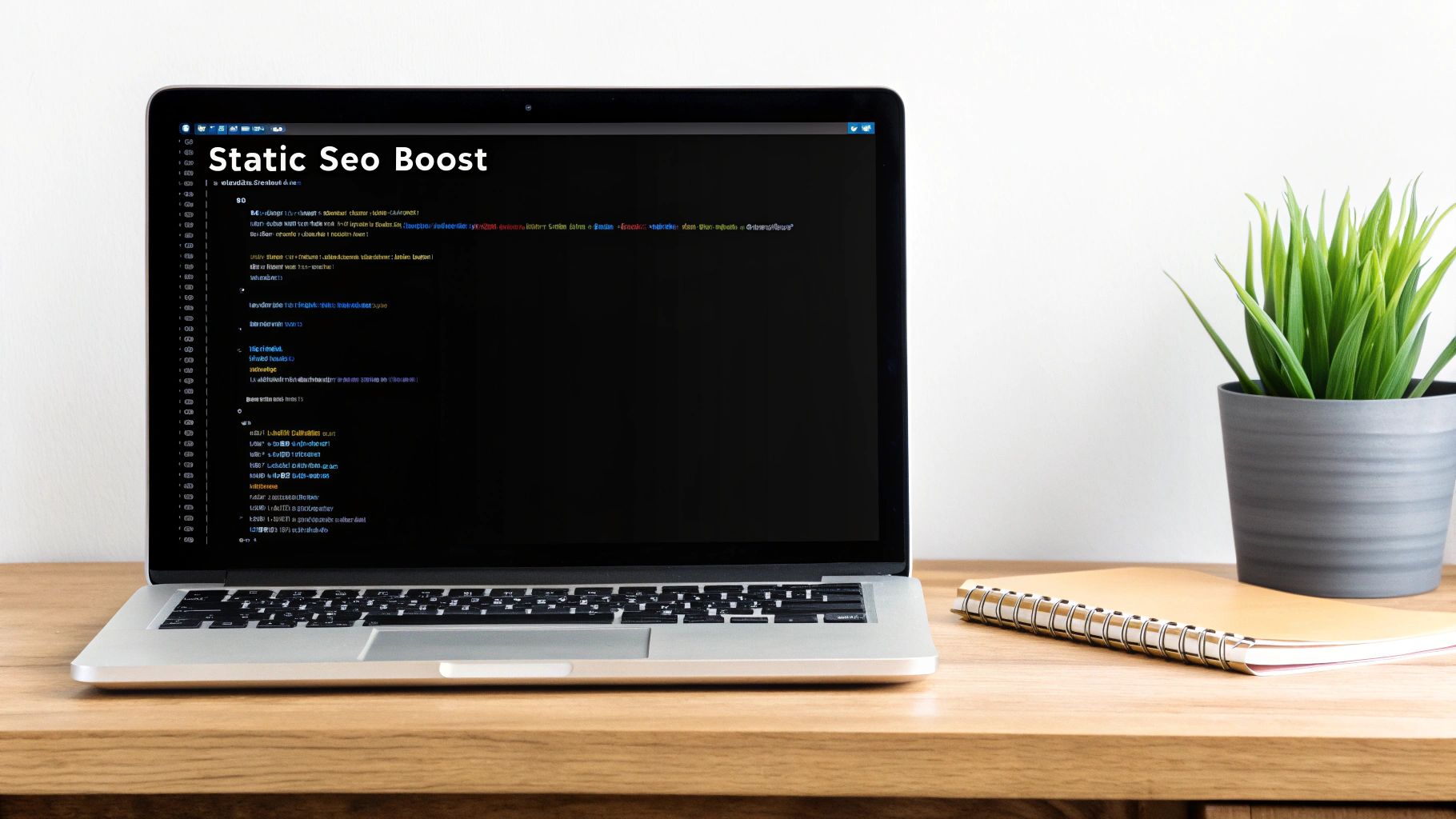
The editing interface itself gives you a clean, side-by-side view of your content and a live preview. This instant feedback is invaluable for making sure your content structure, from headings down to embedded images, looks exactly right before you hit publish.
Taking Direct Control of Your On-Page SEO
JekyllPad gives you total, fine-grained control over the most important on-page SEO elements, and you don't have to touch a single line of code to do it. It makes managing "front-matter"—the block of metadata at the top of each file that dictates how a page is built—incredibly simple.
This is where you can easily handle the SEO essentials:
- Meta Title: Write a compelling, keyword-rich title to grab attention in search results.
- Meta Description: Craft that perfect summary to convince users to click.
- Canonical URL: Tell search engines which version of a page is the "master copy" to avoid duplicate content penalties.
- Custom Slugs: Create clean, descriptive, and user-friendly URLs for every single post.
Because every tweak is a direct commit to your GitHub repository, you automatically get a version-controlled history of all your SEO optimizations. This creates a crystal-clear audit trail, making it a breeze to track the impact of your changes over time.
With JekyllPad, you’re not wrestling with a clunky interface or fighting against plugin bloat. You're working directly with the building blocks of your content, ensuring every page is structured for maximum visibility from the moment you hit "save."
Streamlined Content Creation for Better SEO
A huge part of on-page SEO comes down to the quality and structure of your content. JekyllPad’s Markdown editor naturally encourages you to create well-organized articles using a proper heading hierarchy (H1, H2, H3), which is a fundamental signal that search engines use to understand your content.
Something as simple as embedding an optimized image with proper alt text becomes a drag-and-drop affair. This seamless workflow removes the friction that so often leads to teams skipping crucial SEO steps, like adding descriptive alt text.
By making best practices the easiest path forward, JekyllPad helps ensure they’re followed consistently. That consistency builds a much stronger foundation for your site's long-term search performance.
How to Choose Your Next SEO-Friendly CMS
Picking a new CMS feels like a huge commitment, and honestly, it is. It's a decision that can either supercharge your SEO for years to come or leave you fighting an uphill battle against your own platform. The right CMS makes optimization a natural part of your workflow, while the wrong one feels like a constant source of friction.
The trick is to look past the flashy marketing features and dig into the core functionality. Think of it less like shopping and more like an inspection. You're kicking the tires to see how the system handles the absolute essentials of search visibility. A truly SEO-friendly CMS doesn't just bolt on SEO features; it's built with search in mind from the ground up.
A Practical Evaluation Checklist
When you're vetting a new CMS or re-evaluating your current one, this simple framework will help you cut through the marketing fluff and get straight to what matters for organic growth.
Code & Performance Audit: Does this thing generate clean code? Pull up a few demo sites built on the platform and run them through Google PageSpeed Insights. You're looking for high scores on Core Web Vitals. If the demo sites are slow, that’s a massive red flag.
Metadata & Schema Control: How much control do you really have over the on-page basics? You should be able to easily edit meta titles, descriptions, and canonical tags on every single page without jumping through hoops. Beyond that, check how it handles structured data (Schema markup). If you need a clunky plugin or a developer just to add basic Schema, keep looking.
Content & URL Management: Can you easily create clean, keyword-focused URLs? Or are you stuck with a clunky, auto-generated structure? The content editor itself should make it dead simple to use proper headings (H1, H2, H3) to structure your articles. Your CMS should empower content creators, not box them in with rigid templates.
Workflow & Integration: Think about how your team actually works. For developers, a CMS that plays nice with modern tools is a must. A platform like JekyllPad, which works directly with Git, offers version control and makes deployment a breeze. This Git-based approach also sidesteps the database entirely, getting rid of a common source of site slowness.
Your Goal: Find a CMS that gives you a clear "yes" to these questions without hesitation. The less time you spend wrestling with your own platform to implement SEO fundamentals, the more time you have to create content that actually earns rankings.
An SEO-friendly CMS should feel like an accelerator for your organic growth, not a speed bump.
Frequently Asked Questions
When you're trying to nail your SEO, the content management system you choose can feel like a huge, make-or-break decision. It's easy to get lost in the technical jargon. Let's clear up a few of the most common questions people have when picking a CMS that's friendly for SEO.
Is a Headless CMS Automatically SEO-Friendly?
Not on its own, but it sets the stage for incredible SEO. Think of a headless CMS as a high-performance engine; it gives developers the freedom to build a custom, lightning-fast front-end around it. The final SEO results, however, live or die by how well that front-end is actually built.
The real advantage here is unlocking the potential for top-tier SEO, rather than getting it pre-packaged right out of the box.
Can I Achieve Good SEO with WordPress?
You absolutely can, but it takes work and a watchful eye. The biggest SEO hurdle with WordPress is performance bloat. This usually comes from clunky themes and piling on too many plugins, which can slow your site to a crawl. To make it work, you have to be disciplined: pick a lightweight theme, be ruthless about which plugins you install, and get a solid caching system in place.
It's a constant battle to keep a WordPress site lean and fast, while static site generators are built that way from the ground up.
People often think there's a "magic bullet" CMS for SEO. The reality is that the best platform is the one that gets technical roadblocks out of your way. It should let your team apply SEO best practices consistently without needing a developer for every little tweak.
How Does a Git-Based CMS Help SEO?
A Git-based CMS offers some powerful, if indirect, benefits that can give you a real edge in the search rankings. First off, by ditching database queries, your website becomes incredibly fast—and speed is a huge ranking factor. The whole workflow also naturally pushes you toward creating clean, well-structured content from day one.
Finally, version control via Git gives you a complete, transparent history of every single change made to your content. This is a game-changer for tracking updates and figuring out how specific edits might have affected your SEO performance over time.
Ready to build a faster, more secure, and SEO-friendly site without the technical headaches? JekyllPad provides the visual editing experience you need with the raw performance of a static site. Try it for free and see how simple managing your content can be. Get started at https://www.jekyllpad.com.