
In an era where website performance, security, and scalability are non-negotiable, static site generators (SSGs) have emerged as the go-to solution for developers and content creators. Unlike traditional dynamic websites that build pages on every request, SSGs pre-build everything into a set of static HTML, CSS, and JavaScript files. This simple yet powerful approach delivers blazing-fast load times, a smaller attack surface, and a simplified hosting experience. The result is a more resilient and efficient web presence, whether for a personal blog or a large-scale documentation portal.
But with a rapidly growing ecosystem, choosing the right tool can feel overwhelming. The differences between popular options involve more than just programming languages; they impact build speeds, developer experience, and content flexibility. Finding the perfect fit depends entirely on your project's specific needs, your team's technical skills, and your long-term goals for content management and scalability.
This comprehensive guide cuts through the noise to help you select from the best static site generators available today. We will analyze the unique strengths, ideal use cases, and practical trade-offs of 12 top-tier tools. We'll explore everything from the raw speed of Hugo to the component-driven flexibility of Astro, providing detailed overviews, pros and cons, and direct links for each. Our goal is to equip you with the insights needed to make an informed decision for your next blog, documentation hub, or high-performance marketing website.
1. Astro
Astro has rapidly emerged as a leading choice among the best static site generators by focusing on a content-first, performance-oriented architecture. Its standout feature is the "Islands Architecture," a partial hydration strategy that ships zero JavaScript by default. This approach allows developers to build rich, interactive user interfaces with frameworks like React, Vue, or Svelte, but only hydrate the specific components that require it, leaving the rest of the site as static, lightweight HTML.

This results in exceptionally fast page loads, making it ideal for content-heavy sites like marketing pages, blogs, and documentation portals where Core Web Vitals are a priority. The developer experience is another significant advantage, with Vite providing near-instant hot module replacement and an intuitive file-based routing system.
Astro is completely free and open source. Deployment is straightforward on any modern static host, including free tiers on platforms like Netlify, Vercel, and Cloudflare Pages. Its growing ecosystem of themes and integrations simplifies project setup. For those managing content, using an Astro headless CMS can further streamline the editorial workflow.
Key Details & Use Cases
| Feature | Description | Best For |
|---|---|---|
| Islands Architecture | Ships minimal to zero JavaScript by default for superior performance. | Content-rich sites, blogs, marketing websites. |
| Framework Agnostic | Use React, Vue, Svelte, Solid, and more within a single project. | Teams with diverse framework expertise. |
| Content Collections | Built-in API for managing and validating Markdown and MDX files. | Documentation sites, knowledge bases. |
| Vite Tooling | Fast build times and an excellent local development experience. | Developers prioritizing a fast, modern workflow. |
- Pros: Excellent performance out of the box, great developer experience, flexible UI framework integration.
- Cons: Newer ecosystem compared to veterans like Jekyll or Hugo; complex, state-heavy applications may require more configuration.
- Website: https://astro.build/
2. Hugo
Renowned for its incredible speed, Hugo is a standout choice among the best static site generators, particularly for projects with extensive content. Written in Go, it compiles websites in milliseconds, making it an ideal solution for large blogs, documentation hubs, and corporate sites where build times are a critical factor. Hugo's "batteries-included" philosophy means it ships with powerful features like image processing, robust taxonomy systems, and multilingual support right out of the box, requiring minimal external dependencies.
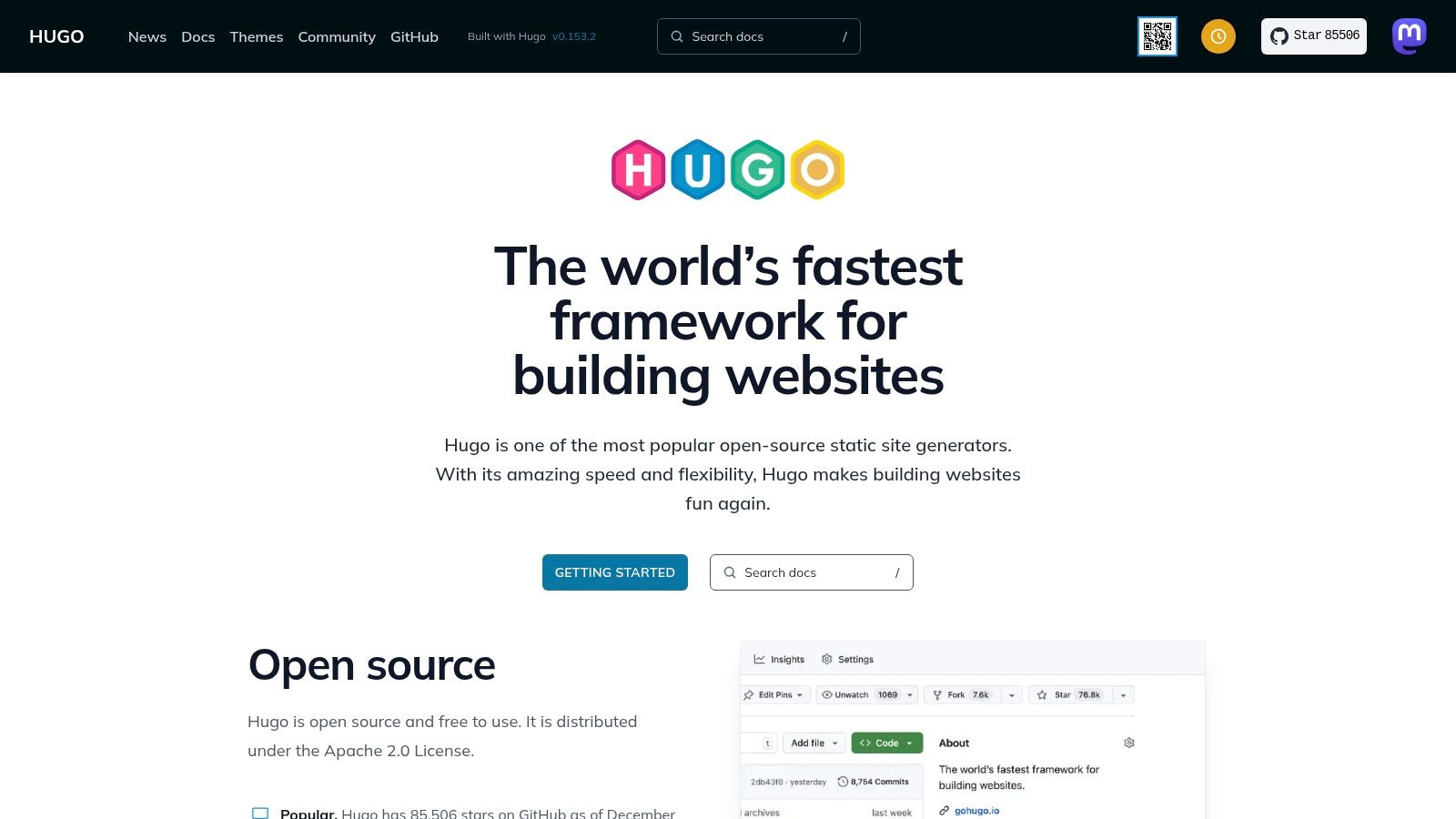
This focus on performance and built-in functionality does not sacrifice flexibility. Its powerful templating engine allows for complex site structures and content relationships. The vibrant community has produced hundreds of themes, enabling developers to get started quickly. For those new to the concept, understanding how an SSG works can highlight why Hugo's speed is such a significant advantage in the development workflow.
Hugo is completely free, open source, and runs as a single binary with no dependencies, simplifying installation and deployment. It is compatible with any static hosting provider, including Netlify, Vercel, and Cloudflare Pages. Its stability and frequent updates make it a reliable tool for long-term projects.
Key Details & Use Cases
| Feature | Description | Best For |
|---|---|---|
| Extreme Speed | Compiles thousands of pages per second, powered by Go. | Large-scale blogs, documentation, corporate websites. |
| Powerful Taxonomies | Built-in support for sophisticated content organization with tags and categories. | Content-heavy sites needing complex filtering. |
| Image Processing | On-the-fly image resizing, cropping, and format conversion without plugins. | Portfolios, photoblogs, and media-rich sites. |
| Multilingual Mode | Native support for building and managing sites in multiple languages. | Global businesses and international projects. |
- Pros: Blazing build times on big sites; mature, stable tool with frequent releases and an active community.
- Cons: Go templating has a learning curve compared with JS-based stacks; fewer app-like patterns compared to React-based frameworks.
- Website: https://gohugo.io/
3. Eleventy (11ty)
Eleventy has gained a dedicated following among the best static site generators by championing simplicity, flexibility, and a content-first philosophy. Unlike more opinionated frameworks, Eleventy makes zero assumptions about your project structure or front-end choices, shipping no client-side JavaScript by default. Its core strength lies in its incredible flexibility with templating languages, allowing developers to use over ten different engines like Liquid, Nunjucks, and Markdown, often within the same project.
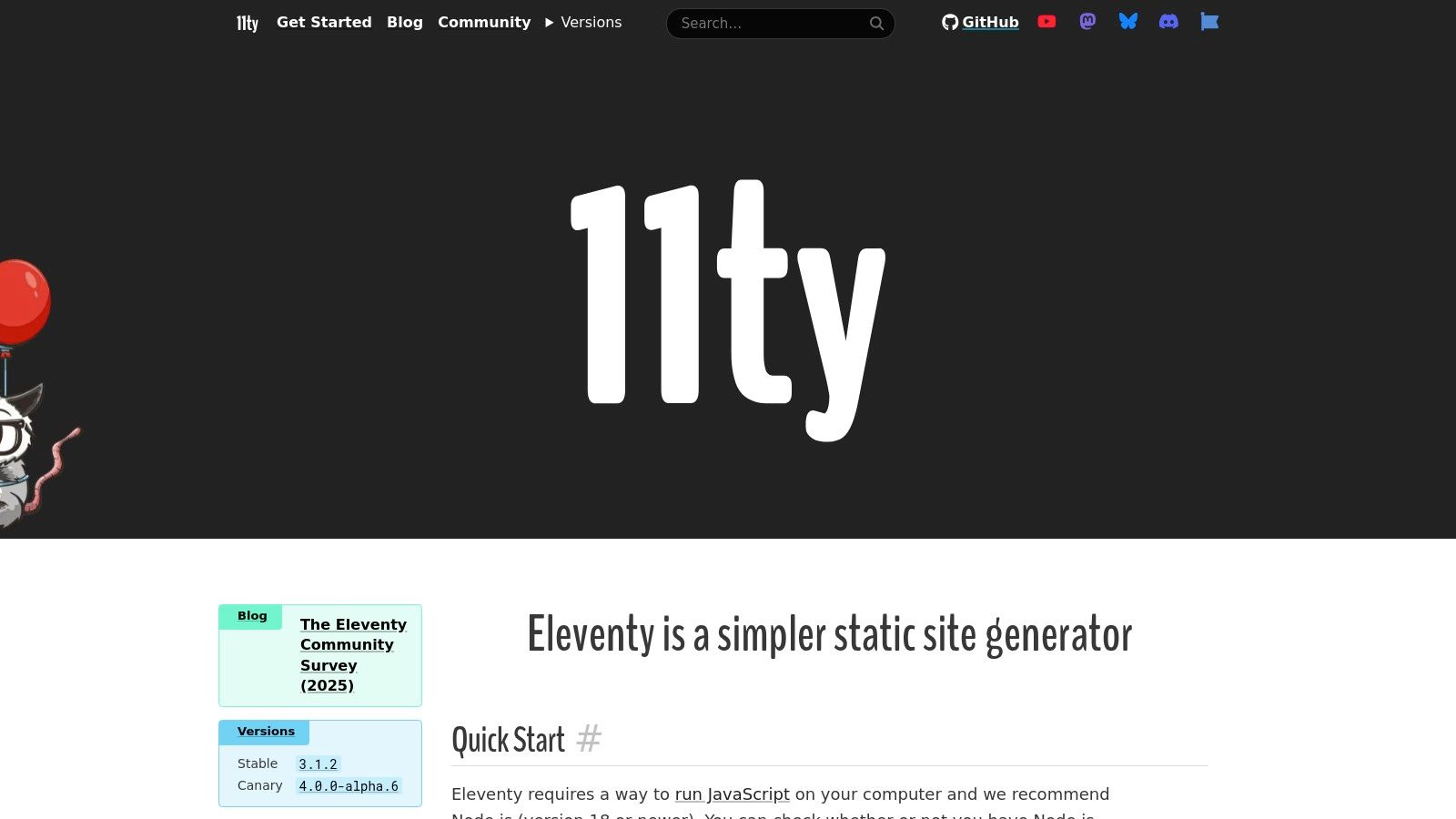
This approach results in lightweight, performant websites that are fast to build and easy to maintain, making it a perfect fit for blogs, documentation sites, and personal portfolios. The developer experience is centered on configuration over code, with a straightforward data cascade that lets you pull content from various sources and inject it precisely where needed.
Eleventy is completely free, open-source, and built on Node.js. It deploys seamlessly to any static hosting provider such as Netlify, Vercel, or GitHub Pages. Its focus on generating lean HTML files without unnecessary overhead makes it an excellent choice for projects where performance and accessibility are paramount.
Key Details & Use Cases
| Feature | Description | Best For |
|---|---|---|
| Template Engine Agnostic | Supports over ten templating languages out of the box. | Developers who want to use familiar syntax like Liquid or Nunjucks. |
| Minimal Runtime | Outputs pre-rendered HTML with zero client-side JavaScript by default. | Performance-critical sites, blogs, and government/enterprise documentation. |
| Flexible Data Sources | Pull content from Markdown, JSON, and even remote APIs. | Content-driven websites with diverse data needs. |
| Simple Configuration | Focuses on a simple, extendable configuration file over complex APIs. | Projects that need to integrate smoothly into existing build processes. |
- Pros: Extremely flexible and unopinionated, excellent performance, supports numerous templating languages.
- Cons: Smaller plugin ecosystem than larger frameworks; complex interactivity requires adding your own JavaScript solutions.
- Website: https://www.11ty.dev/
4. Jekyll
As one of the original pioneers in the space, Jekyll remains one of the best static site generators due to its simplicity, stability, and deep integration with GitHub Pages. Written in Ruby, it transforms plain text into static websites and blogs, making it a reliable choice for personal sites, project documentation, and straightforward content-driven projects. Its "blog-aware" nature means it understands concepts like posts, categories, and permalinks out of the box.

The standout feature is its seamless connection with GitHub, allowing users to push their repository and have a live site hosted for free. This zero-cost workflow has made it a default choice for countless developers and open-source projects. For those new to this ecosystem, a guide on how to use GitHub Pages can streamline the setup process.
Jekyll is completely free and open source. The vast, mature ecosystem provides a wealth of themes, plugins, and community support, ensuring you can find a solution for most common needs. While its build performance may not match newer, compiled generators, its battle-tested reliability is a significant asset.
Key Details & Use Cases
| Feature | Description | Best For |
|---|---|---|
| GitHub Pages Integration | Native support allows for free, automatic deployment from a GitHub repo. | Personal blogs, portfolios, open-source project documentation. |
| Blog-Aware | Built-in logic for posts, categories, tags, and chronological content. | Bloggers and writers who need a simple content structure. |
| Liquid Templating | A flexible and easy-to-learn templating engine for creating layouts. | Developers who prefer logic-based templates over JSX. |
| Mature Ecosystem | A large collection of community-created themes and plugins. | Users looking for established solutions and extensive documentation. |
- Pros: Extremely well-documented with a long history, zero-cost hosting workflow via GitHub Pages for public repositories, simple and easy to learn.
- Cons: Ruby dependency can be unfamiliar to JavaScript-focused teams; build speeds can be slower for large sites compared to modern SSGs.
- Website: https://jekyllrb.com/
5. Gatsby
Gatsby has long been a heavyweight contender among the best static site generators, establishing itself as a powerful, React-based framework for building fast and feature-rich websites. Its defining feature is a unified GraphQL data layer, which allows developers to pull content from virtually any source, including headless CMSs, APIs, databases, or local Markdown files, and query it seamlessly during the build process.

This makes Gatsby an excellent choice for complex, content-heavy marketing sites, e-commerce stores, and enterprise-level applications that aggregate data from multiple systems. While it pre-renders pages into static HTML for incredible speed, it also supports modern rendering options like Server-Side Rendering (SSR) and Deferred Static Generation (DSG) for greater flexibility.
Gatsby is free and open-source, with a vast ecosystem of plugins, starters, and themes that accelerate development. Its powerful image optimization tools are a major plus, automatically creating responsive, lazy-loaded images to boost performance. Deployment is standard on any static host, with official integrations for platforms like Netlify and Vercel.
Key Details & Use Cases
| Feature | Description | Best For |
|---|---|---|
| GraphQL Data Layer | Unifies content from any CMS, API, or file source into one queryable API. | Sites with multi-source content, enterprise applications. |
| Plugin Ecosystem | A massive library of plugins for data sources, image optimization, and more. | Rapidly adding complex features and integrations. |
| Hybrid Rendering | Supports static generation, SSR, and DSG for flexible rendering strategies. | Dynamic applications, personalized content. |
| Performance Tooling | Built-in image optimization, code splitting, and prefetching. | Marketing sites and e-commerce where speed is critical. |
- Pros: Exceptional for integrating multiple content sources, mature ecosystem with extensive tooling, strong performance optimizations.
- Cons: Higher build complexity and longer build times than lighter generators; some documentation and starters can feel dated.
- Website: https://www.gatsbyjs.com/
6. Docusaurus
Docusaurus is a specialized yet powerful option among the best static site generators, purpose-built by Facebook for creating pristine documentation websites with minimal effort. It leverages React and MDX, allowing developers to embed interactive components directly within Markdown files, creating a richer, more engaging user experience than traditional static documentation. The entire platform is engineered to streamline the process of building and maintaining content-heavy knowledge bases.

Its core strength lies in providing essential documentation features out of the box, such as versioning for different software releases, internationalization (i18n) for multilingual support, and pre-configured Algolia search integration. This focus allows teams to launch a fully-featured, professional-looking documentation site incredibly quickly, bypassing the need to build these complex features from scratch.
Docusaurus is completely free and open-source. Since it builds to a standard static site, it can be deployed on any modern static hosting provider like Netlify, Vercel, or GitHub Pages. The setup process is well-documented and straightforward for those familiar with the React ecosystem.
Key Details & Use Cases
| Feature | Description | Best For |
|---|---|---|
| MDX Content | Embed interactive React components directly inside Markdown files. | Creating interactive tutorials and API references. |
| Built-in Versioning | Maintain and display documentation for multiple versions of a product. | Software projects, API documentation. |
| Localization (i18n) | Tools to translate content and serve the site in multiple languages. | Global products and open-source projects. |
| Algolia Search | First-class, out-of-the-box integration with a powerful search provider. | Large knowledge bases needing fast, reliable search. |
- Pros: Rapid time-to-value for product and API documentation, excellent built-in features, active maintenance and great documentation.
- Cons: Optimized for docs, so general marketing sites require significant theming; React/MDX stack can be overkill for simple content.
- Website: https://docusaurus.io/
7. VitePress
VitePress leverages the power of Vite and Vue to offer one of the best static site generators specifically optimized for speed and simplicity. It was created to power the documentation for Vue.js and its ecosystem projects, providing a streamlined experience for building content-centric sites. Its key advantage is the near-instant server start-up and lightning-fast Hot Module Replacement (HMR), which dramatically improves the development workflow.

The framework uses Vue-enhanced Markdown, allowing you to seamlessly embed interactive Vue components directly within your static content. This makes it an excellent choice for technical documentation, tutorials, and knowledge bases where interactive examples or dynamic elements are needed. The out-of-the-box theme is clean, responsive, and packed with features expected from a modern documentation site, including a sidebar, search, and dark mode.
VitePress is free, open source, and built for performance. While its default configuration is tailored for documentation, its flexible APIs for routing and data loading allow for customization into other types of static websites. For teams already comfortable with the Vue ecosystem, VitePress offers a familiar and highly efficient development environment.
Key Details & Use Cases
| Feature | Description | Best For |
|---|---|---|
| Vite-Powered DX | Instant server startup and near-instant HMR for a fast development loop. | Developers prioritizing a rapid, modern workflow. |
| Vue in Markdown | Embed interactive Vue components directly inside Markdown content. | Technical documentation with interactive examples. |
| Docs-Oriented Theme | A feature-rich default theme with search, sidebars, and customizable navigation. | Software documentation, knowledge bases, tutorials. |
| Performance-First | Produces a fast, lightweight static site with minimal JavaScript overhead. | Content-heavy sites where load speed is critical. |
- Pros: Extremely fast developer experience and build performance; simple configuration; great choice for Vue teams.
- Cons: Smaller ecosystem compared to Docusaurus or Astro; primarily docs-focused by default and requires comfort with Vue for custom interactivity.
- Website: https://vitepress.dev/
8. Next.js (Static Site Generation)
While known as a full-stack React framework, Next.js provides one of the most powerful and flexible environments among the best static site generators. It allows developers to pre-render pages at build time (Static Site Generation, or SSG) on a per-page basis, offering the performance benefits of a static site while retaining the power to use server-side rendering (SSR) or incremental static regeneration (ISR) for other pages within the same application. This hybrid approach gives teams ultimate control over their rendering strategy.
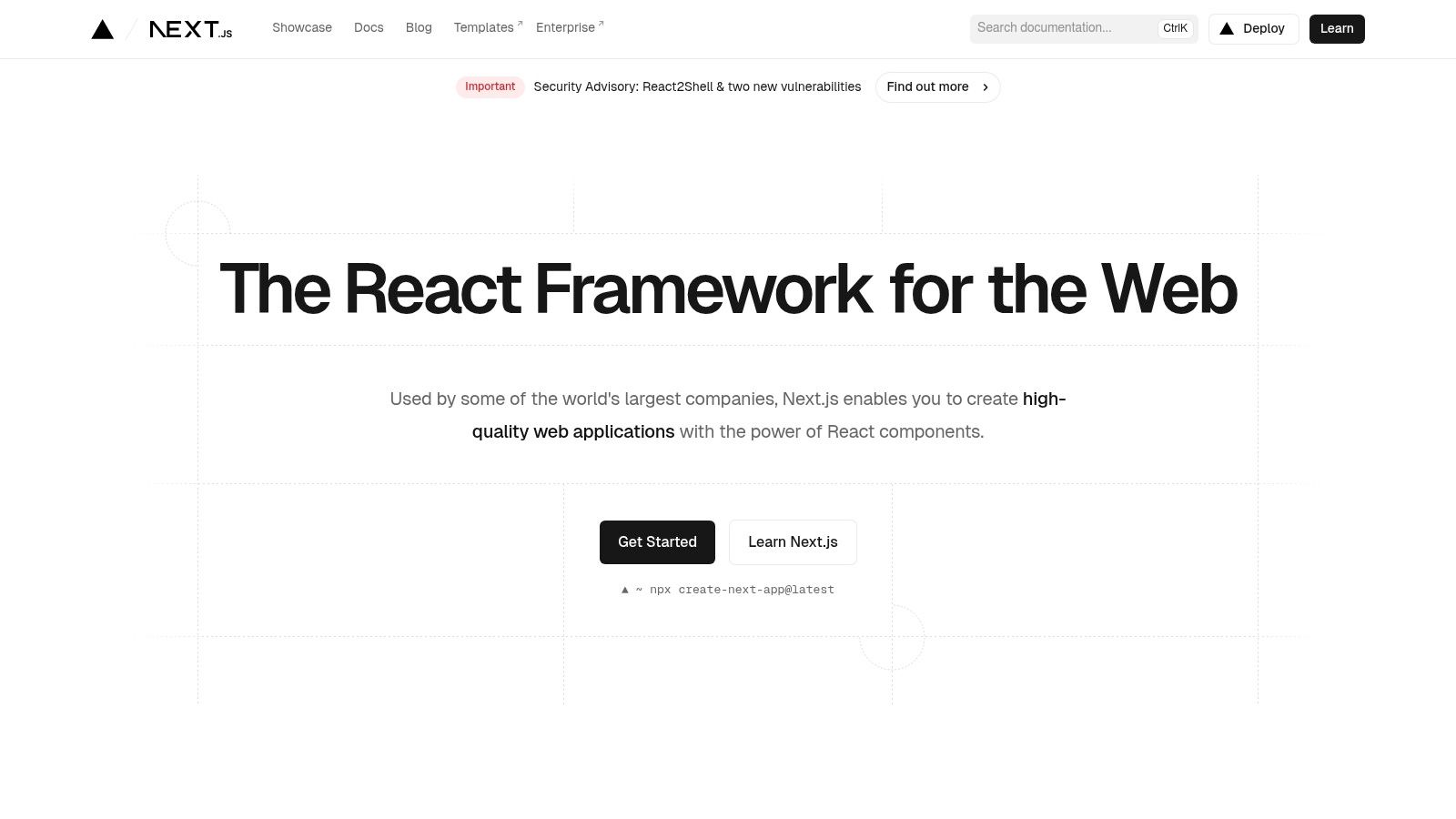
This makes Next.js a fantastic choice for large-scale applications where some content is static, like marketing pages and blog posts, while other parts require dynamic, user-specific data, like an e-commerce dashboard. The developer experience is world-class, backed by Vercel with robust tooling, automatic optimizations, and a massive community.
Next.js is open source and completely free to use. Its deep integration with Vercel provides a seamless deployment experience, though it can be hosted on any platform that supports Node.js. The framework's ability to evolve a project from a simple static site into a complex, dynamic application without changing tools is a significant advantage for long-term projects.
Key Details & Use Cases
| Feature | Description | Best For |
|---|---|---|
| Hybrid Rendering | Mix static generation (SSG), SSR, and ISR on a per-page basis. | Complex web applications, e-commerce stores, large portals. |
| React Ecosystem | Leverages the entire React ecosystem for UI components and libraries. | Teams with existing React expertise or building React apps. |
| Automatic Optimization | Built-in image, font, and script optimizations for top performance. | Performance-critical sites requiring fine-tuned optimization. |
| App & Pages Routers | Granular control over rendering, data fetching, and layouts. | Developers needing precise control over application architecture. |
- Pros: Extremely flexible rendering strategies, excellent developer experience, and a vast ecosystem of tools and libraries.
- Cons: Can be overkill for simple static-only sites due to framework overhead; the best experience is often tied to Vercel.
- Website: https://nextjs.org/
9. Nuxt (Static Generation)
Nuxt is a powerful Vue-based framework that excels at more than just dynamic applications; it is also one of the best static site generators available for developers in the Vue ecosystem. Its hybrid nature allows you to prerender your entire site into static HTML using the nuxi generate command. This process leverages an internal crawler to discover and build all your routes, resulting in a highly performant, SEO-friendly static output that can be deployed to any static host.
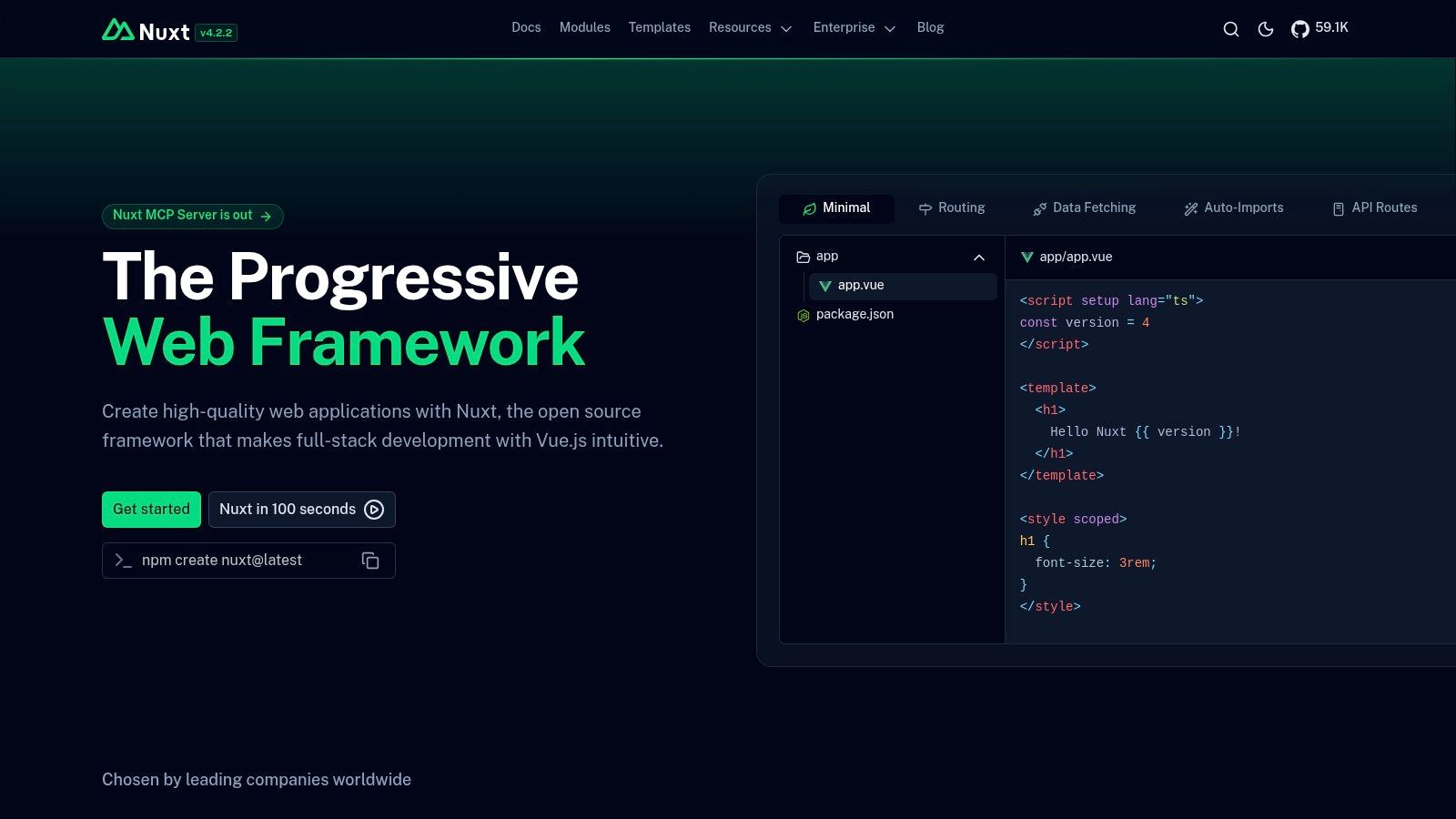
The framework's true strength in static generation is amplified by its rich module ecosystem. For instance, Nuxt Content transforms it into a Git-based headless CMS, perfect for building blogs, documentation, and portfolios directly from Markdown files. This integration provides an excellent developer experience with features like hot module reloading and a cohesive project structure.
Nuxt is free, open-source, and offers flexible deployment targets, from static hosts like Netlify and Vercel to server-based environments if your project needs evolve. The ability to start static and scale to more complex rendering strategies makes it a versatile and future-proof choice.
Key Details & Use Cases
| Feature | Description | Best For |
|---|---|---|
| Static Generation | Prerenders the entire application into static HTML files for peak performance. | Marketing sites, blogs, portfolios, and documentation. |
| Nuxt Content Module | A Git-based headless CMS for authoring content in Markdown, YAML, and CSV files. | Content-heavy sites managed by developers. |
| Vue Ecosystem | Leverages the full power of Vue.js, including components, reactivity, and tooling. | Teams already proficient with or invested in Vue.js. |
| Hybrid Rendering | Offers flexibility to mix static generation with server-side or client-side rendering. | Projects that may need to scale beyond purely static content. |
- Pros: Mature Vue ecosystem, excellent developer experience, flexible rendering and deployment options.
- Cons: Advanced features can require broader Nuxt ecosystem knowledge; static generation nuances differ between Nuxt 2 and Nuxt 3.
- Website: https://nuxt.com/
10. SvelteKit (adapter-static)
While primarily known as an application framework, SvelteKit earns its place among the best static site generators through its powerful adapter-static. This feature allows developers to prerender an entire application into static HTML and CSS, producing exceptionally small client-side bundles. The core philosophy of Svelte, which compiles components to highly optimized vanilla JavaScript at build time, is the driving force behind its incredible performance.
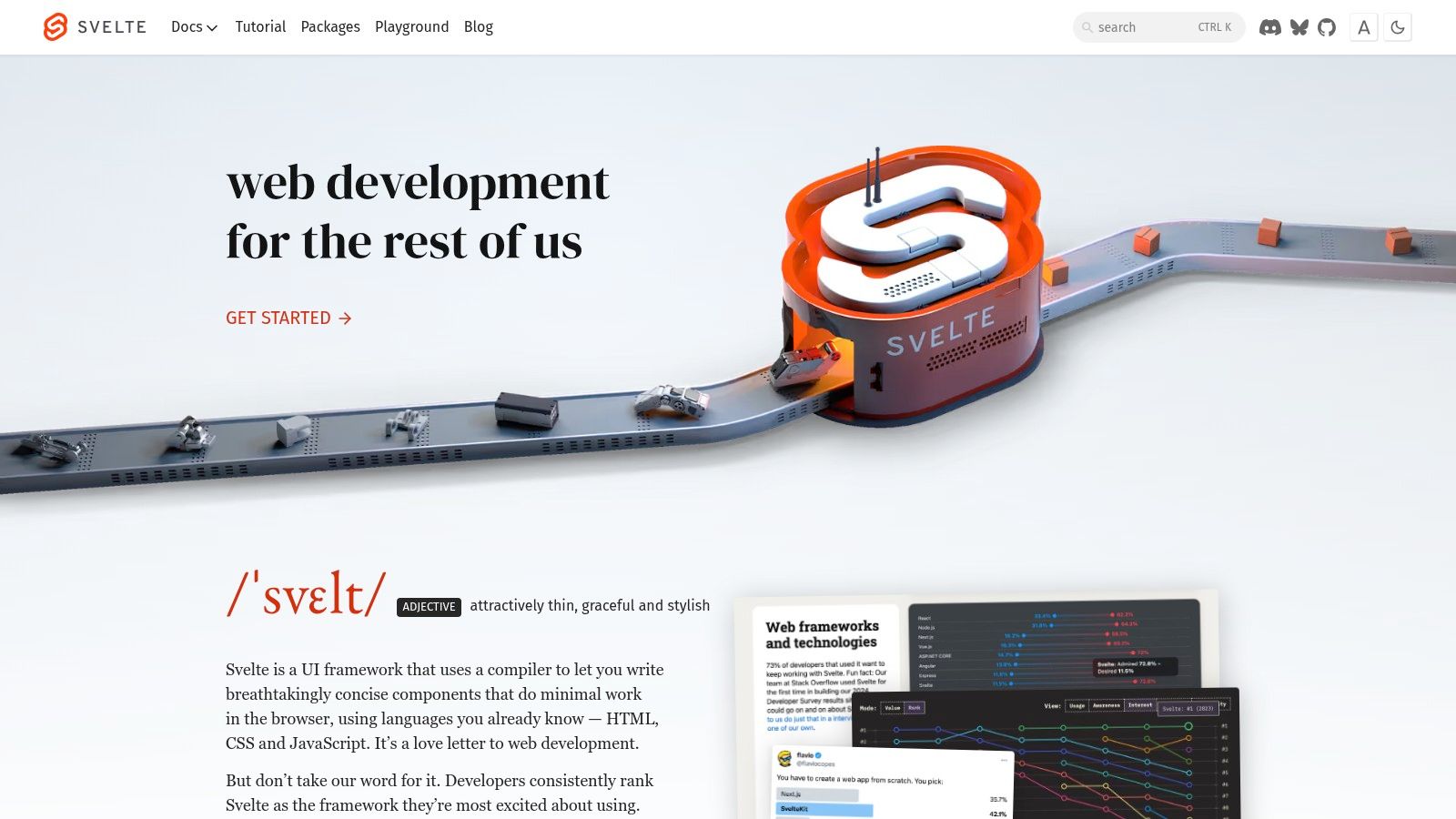
This approach delivers the rich interactivity and developer experience of a modern framework while producing output that is as fast and lightweight as a traditional static site. The developer ergonomics are a major highlight, with a simple and intuitive API that feels both productive and enjoyable to work with. SvelteKit also offers granular control, allowing specific pages to be prerendered while others remain dynamic, offering a flexible path for future growth.
SvelteKit is free, open source, and can be deployed to any static host like Netlify, Vercel, or GitHub Pages. The adapter system simplifies deployments by tailoring the build output for specific platforms, making it a versatile choice for projects that prioritize performance and a clean, component-based architecture.
Key Details & Use Cases
| Feature | Description | Best For |
|---|---|---|
| Compiler-Based Framework | Svelte compiles code to tiny, framework-less vanilla JS for peak performance. | Performance-critical projects like portfolios and marketing sites. |
Static Adapter (adapter-static) |
Enables full prerendering of the entire site into static assets. | Blogs, documentation sites, and any content-first website. |
| Flexible Prerendering | Prerender specific pages or the entire application as needed. | Projects that may start static but could need server-side logic later. |
| First-Class Tooling | Benefits from Vite for a fast, modern development server and build process. | Developers who value a streamlined, ergonomic workflow. |
- Pros: Superb performance and developer ergonomics; easy to produce fully static output suitable for CDN hosting.
- Cons: Smaller ecosystem than React/Vue; some integrations may require custom work; framework evolves frequently.
- Website: https://kit.svelte.dev/
11. MkDocs
MkDocs is a Python-based static site generator purpose-built for creating project documentation. It distinguishes itself from other best static site generators with its extreme simplicity, using just Markdown for content and a single YAML file for configuration. This straightforward approach allows writers and developers to focus entirely on creating clear, well-structured documentation without getting bogged down in complex templating or build configurations.

The platform includes a built-in development server with live reloading, providing immediate feedback as you write. While its core is minimalistic, its functionality can be greatly extended through a rich ecosystem of themes and plugins. Popular themes like Material for MkDocs can transform a basic site into a modern, feature-rich documentation portal with advanced search, versioning, and navigation.
MkDocs is completely free and open source. Because it generates standard static files, deployment is simple on services like GitHub Pages, AWS S3, or any static web host. Its singular focus makes it an incredibly efficient tool for its specific niche, prioritizing ease of use and maintainability for documentation-centric projects.
Key Details & Use Cases
| Feature | Description | Best For |
|---|---|---|
| Simple Configuration | Uses a single YAML file and Markdown for all content and structure. | Software projects, API documentation, internal knowledge bases. |
| Plugin Architecture | Extensible with community-built plugins for search, diagrams, and more. | Teams needing specific documentation features. |
| Theming System | Easily apply pre-built themes like Read the Docs or Material. | Creating professional-looking documentation with minimal effort. |
| Built-in Dev Server | Includes a local server that automatically reloads on changes. | A fast and efficient authoring workflow. |
- Pros: Very simple authoring model ideal for documentation teams, stable and mature project, excellent community themes.
- Cons: Less suited for non-documentation sites like blogs or portfolios, Python dependency might not fit JavaScript-only workflows.
- Website: https://www.mkdocs.org/
12. Hexo
Hexo is a fast, simple, and powerful blog-focused framework that stands out as one of the best static site generators for personal blogs and portfolios. Built on Node.js, it prioritizes speed and simplicity, enabling developers to generate a complete website from Markdown files with just a few commands. Its core strength lies in its extensive ecosystem of themes and plugins, which allows for rapid setup and customization without needing to build everything from scratch.
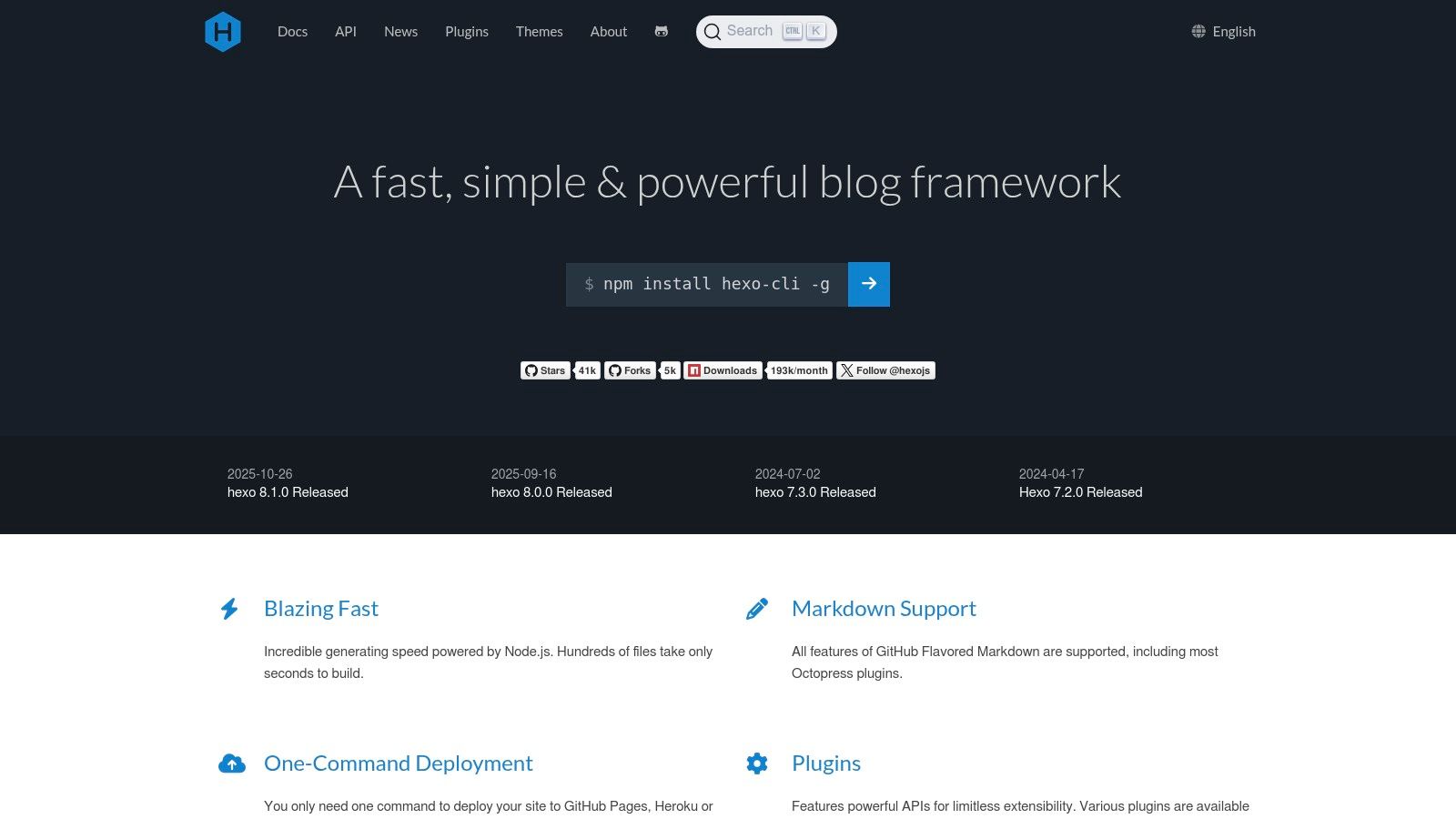
The framework is highly extensible, supporting popular template engines like EJS, Pug, and Haml. One of Hexo’s most popular features is its one-command deployment, simplifying the process of publishing a site to platforms like GitHub Pages, Heroku, and Netlify. This streamlined workflow makes it an excellent choice for developers who want to focus on writing content rather than wrestling with complex configurations.
Hexo is completely free, open-source, and well-documented. Its straightforward CLI and Markdown-first approach make it accessible for beginners while offering enough flexibility for more experienced users to extend its functionality.
Key Details & Use Cases
| Feature | Description | Best For |
|---|---|---|
| Node.js-Powered Speed | Fast file generation and a responsive CLI for a smooth workflow. | Developers seeking a quick and efficient build process. |
| Extensive Ecosystem | Hundreds of community-contributed themes and plugins available. | Quickly launching stylized blogs, portfolios, or docs. |
| One-Command Deployment | Built-in deployers for GitHub Pages, Netlify, Vercel, and more. | Streamlining the publishing process for frequent writers. |
| Markdown-First | Natively supports GitHub Flavored Markdown and other renderers. | Content creators who prefer writing in Markdown. |
- Pros: Very fast site generation, easy-to-use CLI, large theme and plugin catalog for quick project starts.
- Cons: Blog-first mindset means complex sites may require more customization; smaller enterprise footprint compared to Next.js or Hugo.
- Website: https://hexo.io/
Top 12 Static Site Generators — Feature Comparison
| Platform | Core strengths | Dev UX & Performance | Best for (👥) | Unique selling point |
|---|---|---|---|---|
| Astro | Hybrid Islands, multi-framework, minimal JS | ★★★★★ — fast, performant | 👥 Performance-focused devs & content sites | ✨ Minimal client JS + framework-flex ⚡️🏆 |
| Hugo | Extremely fast builds, image processing, taxonomies | ★★★★★ — blazing builds for large sites | 👥 Large content sites, multilingual docs | 🏆 Build speed & built‑in image pipeline |
| Eleventy (11ty) | Multi templating, minimal runtime, flexible output | ★★★★☆ — lightweight, adaptable | 👥 Content-first devs & docs teams | ✨ Template freedom, tiny output |
| Jekyll | GitHub Pages integration, blog features, Liquid | ★★★☆☆ — stable, slower builds | 👥 Individuals, blogs & GitHub Pages users | 🏆 Native GitHub Pages workflow |
| Gatsby | GraphQL data layer, plugins, image optimization | ★★★★☆ — powerful but more complex | 👥 Multi-source marketing sites & agencies | ✨ Unified GraphQL data + plugin ecosystem |
| Docusaurus | MDX, versioning, i18n, docs-first navigation | ★★★★★ — fast time‑to‑value for docs | 👥 Product docs teams & OSS projects | 🏆 Built‑in versioning + docs UX |
| VitePress | Vite dev server, HMR, Vue‑enhanced Markdown | ★★★★★ — instant dev & HMR | 👥 Vue teams & technical docs | ✨ Vite-powered HMR + embeddable Vue |
| Next.js (SSG) | Per-page SSG, SSR/ISR mix, strong tooling | ★★★★★ — very flexible, mature | 👥 React teams needing hybrid rendering | 🏆 Granular rendering control across app |
| Nuxt (Static) | nuxi generate, crawler prerender, modules | ★★★★☆ — solid DX for Vue content | 👥 Vue developers & content sites | ✨ Nuxt Content + rich module ecosystem |
| SvelteKit (adapter-static) | Full prerender, tiny bundles, adapters | ★★★★★ — superb perf & ergonomics | 👥 Svelte devs & performance-focused sites | 🏆 Minimal client bundles, great DX |
| MkDocs | Markdown + YAML, live reload, docs themes | ★★★★☆ — simple, stable authoring | 👥 Docs teams & Python projects | ✨ Straightforward docs workflow |
| Hexo | Blog-first, large theme catalog, CLI deploy | ★★★★☆ — fast gen & easy deploy | 👥 Bloggers & portfolios | ✨ Hundreds of themes + one‑command deploy |
How to Choose the Right Static Site Generator for Your Project
Navigating the landscape of the best static site generators can feel overwhelming, but the journey to selecting the perfect tool is less about finding a single "best" option and more about identifying the right fit for your specific project and team. As we've explored, the ecosystem is rich and diverse, offering specialized solutions for nearly every imaginable use case. Your final decision hinges on a careful evaluation of your unique priorities.
The key takeaway is that there is no one-size-fits-all answer. The ideal SSG is a reflection of your project's goals, your team's technical comfort zone, and your long-term vision for content and features.
Synthesizing Your Decision: Key Factors to Revisit
Before making a final choice, condense your requirements by asking these critical questions:
What is our team's primary skillset? If your team is fluent in Go, Hugo is a natural fit. If JavaScript is your core competency, tools like Astro, Eleventy, Next.js, or Gatsby offer a familiar environment. For Python developers, MkDocs provides a straightforward path. Aligning the tool with existing skills dramatically reduces the learning curve and accelerates development.
What is the project's core purpose?
- Blazing-Fast Blogs & Content Sites: For projects where build speed and performance are non-negotiable, Hugo is often the undisputed champion due to its compiled Go binary.
- Complex Web Applications & Interactive Sites: If your site requires rich interactivity and leverages a specific UI library, Astro's island architecture or framework-centric generators like Gatsby (React) and Nuxt (Vue) are superior choices.
- Technical Documentation: For documentation-heavy sites, specialized tools like Docusaurus, VitePress, and MkDocs provide immense value out-of-the-box with features like versioning, search, and internationalization.
- Simplicity & Flexibility: For developers who value a minimal, unopinionated foundation, Eleventy (11ty) offers unparalleled flexibility, allowing you to bring your own templating languages and project structure.
How will content be managed? This is a crucial, often overlooked, consideration. Will developers be the only ones committing content via Git? Or do you need to empower non-technical stakeholders like marketers, writers, and editors? The traditional SSG workflow, centered on the command line and code editors, can become a significant bottleneck for content-driven teams.
Bridging the Gap Between Power and Usability
The true power of a static site is unleashed when your entire team can contribute effortlessly. While the performance and security benefits of an SSG are clear, the content creation process can be intimidating for those unfamiliar with Git, Markdown, and YAML front matter. This is where the workflow becomes just as important as the technology.
Solving this content management challenge is essential for scaling your static site. You need a system that respects the developer's Git-based workflow while providing a simple, intuitive interface for content creators. This ensures that your choice of one of the best static site generators doesn't inadvertently create a barrier for the very people who need to use it most. By planning for content management from the start, you set your project up for sustainable success, allowing you to fully capitalize on the speed, security, and scalability that modern static sites offer.
Ready to pair the power of your chosen SSG with a seamless content workflow? JekyllPad provides a simple, browser-based visual editor that connects directly to your GitHub repository, empowering your entire team to manage content for Jekyll, Hugo, Astro, and other static sites without writing code. Streamline your content operations and unlock your team's full potential by trying JekyllPad today.