
At its core, a Static Site Generator (SSG) is a tool that builds a complete website before anyone even visits it. Instead of a traditional website that generates pages on the fly for every single visitor, an SSG pre-builds every page one time, during a development step called the "build process." The result is a set of simple HTML, CSS, and JavaScript files that are ready to go.
This approach creates websites that are incredibly fast, more secure, and much easier to host.
How a Static Site Generator Actually Works
Think of it like a restaurant. A traditional, dynamic website is like a restaurant where the chef cooks every meal to order. When a customer arrives, the chef gets the raw ingredients, cooks the dish, and then serves it. It works, but it takes time for every single order.
An SSG is more like a high-end bakery that prepares all its best-selling pastries first thing in the morning. When you walk in, your croissant is already baked, perfect, and waiting for you. There's no delay.
That's precisely what an SSG does for your website. It "pre-bakes" every page into a simple HTML file. This eliminates the need for a server to process code, query a database, and piece a page together every time someone clicks a link. The finished files are just sitting there, ready to be served instantly.
The Build-Time Advantage
The real magic of an SSG happens during what's known as build time. This is the moment you run a command, and the generator kicks into gear. It grabs your content (maybe from Markdown files), merges it with your design templates, pulls in any other data, and spits out a complete, fully-functional website.
Once that build process is finished, you have a simple folder full of static assets. These are the files you upload to your web host. Because there's no complex server-side logic running when a user visits your site, the page loads in a flash.
This workflow has some major benefits:
- Blazing-Fast Performance: Serving pre-built HTML files directly from a Content Delivery Network (CDN) is just about the fastest way to get a webpage in front of a user.
- Enhanced Security: With no active database or server code to hack, the potential points of attack for malicious actors are dramatically reduced.
- Simplified Hosting: Static files are lightweight and can be hosted almost anywhere, often for free on highly reliable and scalable services.
This simple workflow—from code to live site—is one of the biggest draws of using an SSG.
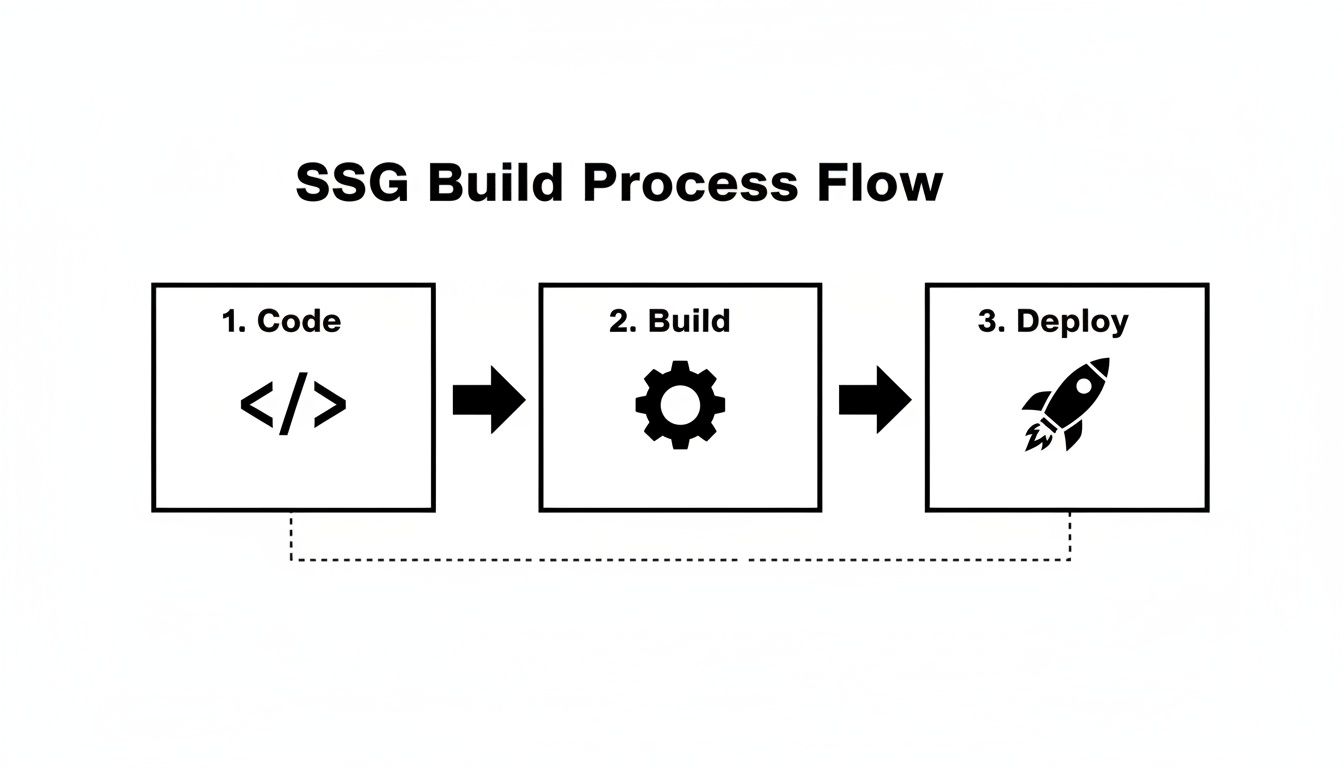
As the diagram shows, all the heavy lifting happens upfront during the build. This makes the deployed, live website incredibly efficient and resilient. This pre-rendering philosophy is the key concept behind the impressive performance of modern static websites. If you want to dig deeper into the mechanics, this resource on Static Site Generation offers a great technical overview.
To put it all together, here's a quick summary of what makes a static site what it is.
Key Characteristics of a Static Site
| Characteristic | What It Means for Your Website |
|---|---|
| Pre-Rendered HTML | All pages are generated as HTML files before deployment. |
| No Database | Content is typically stored in flat files (like Markdown), not a live database. |
| Server-Agnostic | Can be hosted on any simple web server or CDN; no special software needed. |
| Git-Based Workflow | Changes are managed through version control, triggering a new build. |
Ultimately, these characteristics define the SSG approach: build everything in advance to deliver a faster, safer, and simpler final product.
Understanding the Core Components of an SSG
So, we've talked about the "pre-baking" philosophy behind Static Site Generators. Now, let's get into the kitchen and see what ingredients make it all happen. An SSG isn't a single magical program; it's more like a clever engine that combines your templates with your raw content, turning simple text files into a fully-functional website.
At its heart, every SSG orchestrates a simple but powerful combination of parts that work together beautifully.

The Three Essential Ingredients
To build a static site, the generator needs three key things to do its job. Think of these as the fundamental building blocks that every SSG uses, no matter what specific technology it’s built on.
- A Templating Language: This is the reusable structure for your pages—like a cookie-cutter for your website's layout. It defines common elements like headers, footers, and navigation bars that appear across multiple pages.
- A Data Source: This is your actual content. It’s the text, images, and other information that will fill out your templates. Most of the time, this content lives in simple Markdown files (
.md), but it can also be pulled from an external source like an API. - The Generator Engine: This is the workhorse. It grabs your templates and your data, smushes them together, and spits out the final static HTML files that visitors see in their browsers.
This clean separation of content from presentation is a huge win. It lets writers focus entirely on writing without getting tangled up in web design, while developers can tweak the site's structure and feel independently. This organized workflow is exactly why so many teams have embraced the SSG model.
From Markdown to Magic: A Practical Example
Let’s watch this process unfold. A typical blog post often starts life as a simple Markdown file. This file contains the article's text along with a bit of metadata at the very top, a section known as front matter.
Here’s what a basic Markdown file for a post might look like:
title: "My First Blog Post" date: "2024-10-26" author: "Alex Doe" layout: "post"
Welcome to my new blog! This is where I'll share my thoughts on web development.
When you run the build command, the SSG’s engine springs into action. It reads this file, sees the layout: "post" instruction in the front matter, and goes to find the "post" template file. It then plugs the title, date, and the main content into the right spots within that template's HTML structure. The result? A brand new, perfectly-formed my-first-blog-post.html file, ready to go live.
This automated process is the heart of what an SSG does. It systematically transforms hundreds or even thousands of simple content files into a cohesive website, completely eliminating the need for manual HTML editing on every single page.
Handling this workflow with a visual interface can make things even smoother. For a deeper dive into how a visual editor connects with this system, check out our guide on how JekyllPad works. It shows how we bridge the gap between content creation and your Git repository, making it easy for non-technical users to manage an SSG-powered site.
SSG vs. Dynamic Sites: What’s the Difference?
To really get why Static Site Generators are such a big deal, you have to see how they stack up against the way most websites have been built for decades. The entire game changes based on one simple question: when is the web page built? That single difference creates a ripple effect that touches everything—speed, security, and even how much it costs to run your site.
I like to think of a static site as a pre-printed book. Every single page is finished, bound, and sitting on a shelf, ready to be grabbed by a reader. When you ask for a page, you get it instantly because all the hard work was done way ahead of time.
A dynamic site, on the other hand—think of a classic WordPress blog—is more like a custom meal at a restaurant. When you place your order (by visiting the URL), the server (the chef) springs into action. It grabs ingredients from the database (the pantry), follows a recipe (the template), and cooks up a fresh page just for you. It’s powerful, but that on-the-spot cooking takes time and energy.

The Core Architectural Split
At the heart of it all, the big split between these two methods is what the server and database are doing when a visitor shows up.
With a static site, the server has one job: find the HTML file that's already been made and send it over. That's it. No database lookups, no code running in the background. It’s incredibly simple.
With a dynamic site, the server is a busy worker bee. It has to talk to a database to fetch content, run that content through a templating engine, and assemble the final HTML page from scratch, all before sending it to the user.
This might sound like a subtle technical detail, but it has massive consequences for how a site behaves, especially when a lot of people visit at once.
SSG vs Dynamic CMS: A Head-to-Head Comparison
Choosing the right technology for your project often comes down to weighing the pros and cons of each approach. This table compares the two primary web rendering approaches across key factors to help you make an informed decision.
| Factor | Static Site Generation (SSG) | Dynamic (e.g., WordPress) | Server-Side Rendering (SSR) |
|---|---|---|---|
| Performance | Blazing Fast. Files are pre-built and served directly from a global CDN, making load times almost instant. | Slower. Every page request requires server processing and database queries, which adds latency. | Fast Initial Load. Renders on the server for a quick first paint, but can still be slower than pure static for subsequent interactions. |
| Security | Rock-Solid. With no live database or server-side scripts to exploit, the attack surface is tiny. | More Vulnerable. The database, server code, and plugins are all common targets for hackers. | Moderately Secure. Reduces client-side vulnerabilities but the server remains a potential attack vector. |
| Scalability | Scales Effortlessly. Serving flat files from a CDN can handle huge traffic spikes without breaking a sweat. | Complex to Scale. Requires powerful servers, load balancers, and careful database management to handle high traffic. | Scaling is Possible but Costly. Requires robust server infrastructure similar to dynamic sites. |
| Hosting Cost | Very Low. Static hosting is incredibly cheap, and many providers offer generous free tiers. | Higher. Needs a server capable of running PHP/Python, a database, and ongoing maintenance. | Higher. Server costs are significant due to the on-demand rendering for every user. |
| Developer Workflow | Modern and Flexible. Developers use modern tools, Git-based workflows, and can pick their favorite frameworks. | Often Monolithic. The workflow can feel restrictive, tied to a specific CMS and its plugin ecosystem. | Modern but Complex. Gives developers control but adds complexity to manage the server-side environment. |
Ultimately, the choice depends on your project's specific needs. But for a huge number of websites out there—blogs, marketing sites, documentation, and portfolios—the benefits of a static approach are hard to ignore.
The big takeaway is that SSGs offer a powerful advantage for any site where speed and security come first. It completely simplifies the delivery process by moving the hard work from request time to build time.
While dynamic and server-rendered sites will always have their place for highly interactive, user-specific applications (like social networks or e-commerce dashboards), the tide is turning. The web is demanding better performance and stronger security, and the pre-built, simple nature of static sites is the perfect answer.
The Real-World Benefits of Using a Static Site Generator
The move towards Static Site Generators isn't just a passing trend. It's a smart response to what the modern web demands: websites that are faster, safer, and can handle more traffic without breaking a sweat. Developers are flocking to SSGs because they solve some of the biggest headaches that come with traditional dynamic websites.
These advantages all boil down to one core idea: doing all the heavy lifting upfront.
Let's break down the four game-changing benefits that make SSGs such a big deal.
Unbeatable Performance and Speed
In a world where attention spans are measured in seconds, speed is king. This is where static sites truly shine. Since every page is already built as a simple HTML file, a server can deliver it to a visitor's browser instantly. There’s no waiting around for a server to think, query a database, and piece a page together on the fly.
This isn't just a nice-to-have; it's essential for keeping visitors happy and ranking well on Google. Search engines favor fast websites, and countless studies have shown that even a one-second delay in page load time can send your bounce rate through the roof. An SSG gives you a massive head start.
The inherent speed of static sites is a huge part of a bigger picture. For a deeper dive, check out these key website performance optimization techniques.
A Drastically Smaller Attack Surface
Security is a constant worry for anyone running a website. Dynamic sites, with their complex layers of databases, server-side languages, and plugins, are full of potential doors for hackers to kick open. Every piece of that puzzle is another thing to patch and protect.
Static sites flip the script entirely. By getting rid of the live database connections and server-side processing on the public-facing site, you close off the most common attack routes.
Think of it this way: with an SSG, your live website is just a collection of read-only files. This incredibly simple setup makes it a much harder target to compromise, offering a kind of built-in security that's tough to replicate with a traditional CMS.
Lower Costs and Effortless Scalability
Keeping a dynamic website online often means paying for powerful servers, especially as your traffic grows. More visitors usually mean bigger hosting bills and a more complicated infrastructure to manage.
Static sites, on the other hand, are ridiculously cheap to host. The basic HTML, CSS, and JavaScript files don’t need much power, so they can live on simple, low-cost hosting or even free platforms like GitHub Pages. When these files are served from a Content Delivery Network (CDN), your site can handle massive traffic spikes without even blinking. It just scales.
A Modern Developer Experience
Finally, developers genuinely enjoy working with SSGs. The entire process is built around modern tools and practices that just make sense.
- Version Control: Everything—content and code—can be managed with Git. This gives you a full history of every change, making it easy to collaborate with a team or roll back to a previous version if something goes wrong.
- Flexibility: You aren't locked into a clunky, all-in-one system. Developers can work with the programming languages and frameworks they already know and love.
- Automation: The build process is a perfect candidate for automation. A simple
git pushcan trigger a new build and deploy your changes, making updates fast, frequent, and reliable.
This Git-centric workflow makes the whole process of building and maintaining a website smoother, more predictable, and frankly, a lot more fun for the people doing the work.
How to Choose the Right Static Site Generator

The world of static site generators is brimming with incredible tools, but not all are created equal. Each one has a distinct personality, a set of strengths, and a type of project it's perfectly suited for. Picking the right one from the get-go is less about which one is "best" and more about which one is best for you.
Think of it like picking the right tool for a job. You wouldn't use a sledgehammer to hang a picture frame. In the same way, the SSG that’s perfect for a simple blog might not be the right fit for a complex, interactive web application. Your project's goals, your team's comfort level with certain technologies, and the kind of experience you want to build should guide your decision.
Let's break down some of the most popular options and see where they shine.
Hugo: The Speed Demon
If your project's motto is "need for speed," then Hugo is your tool. Built with the Go programming language, it’s legendary for its mind-blowing build times. We're talking about rendering sites with thousands of pages in just a few seconds. This isn't just a "nice-to-have"—it's a game-changer for large-scale projects.
This makes Hugo a go-to choice for massive blogs, content-rich news sites, and sprawling documentation portals where you’re constantly pushing updates and can't afford to wait minutes for a build to complete.
- Language: Go
- Best For: Huge content sites, blogs with a massive archive, and any project where build speed is your top priority.
- Key Feature: Its single-minded focus on performance means your build times stay lightning-fast, even as your site grows exponentially.
Plus, Hugo is a single binary file. That means no complicated dependencies or setup rituals. You just drop it in and go, which developers absolutely love.
Astro: The Content and Performance Specialist
Astro has made a huge splash with its unique philosophy: ship as little JavaScript as possible. It operates on an "islands architecture," which means your site is static HTML by default, and you opt-in to interactivity on a component-by-component basis. The result is websites that load ridiculously fast, which is fantastic for SEO and keeping users happy.
This makes it perfect for content-driven sites like marketing pages, portfolios, and blogs where performance is king. You can still use your favorite UI frameworks like React or Vue for specific components—like an image carousel or a contact form—without weighing down the entire site. It's the best of both worlds.
To really get the most out of it, you'll want a smooth content workflow. Our guide on using an Astro headless CMS can show you how to pair its front-end power with a friendly editing backend.
Astro's whole approach is about building a fast, static foundation first and then surgically adding bits of interactivity only where you need them. It's a recipe for some of the fastest sites on the web today.
Next.js: The Full-Stack Powerhouse
While many know Next.js as a comprehensive React framework, it also happens to have a world-class static site generation engine built right in. It truly shines when you're building complex, data-heavy sites that need the speed of static but the power of a dynamic application.
If your project involves fetching data from multiple APIs at build time or you need a mix of static pages (like your marketing site) and server-rendered pages (like a user dashboard), Next.js is a phenomenal choice. It blurs the line between a static site and a full-blown web app.
It offers a more structured, application-like environment, making it a top contender for e-commerce stores, SaaS platforms, and other projects where you can't compromise on either performance or functionality.
When to Use an SSG and Common Use Cases
So, how do you know if a Static Site Generator is the right tool for your next project? It really comes down to a simple question: Will most visitors see the same content?
If the answer is a resounding "yes," then an SSG is probably a fantastic choice. Their built-in advantages in performance, security, and simplicity make them a perfect match for any website where the primary goal is delivering content efficiently. This is precisely why they’ve become so popular for projects where speed and reliability are non-negotiable.
Perfect Scenarios for a Static Approach
Don't mistake "static" for "simple." SSGs are the engine behind some of the most sophisticated, high-traffic websites out there. Their pre-built architecture is tailor-made for several common scenarios.
Blogs and Portfolios: This is the classic use case. For a personal blog, a developer’s journal, or a photographer’s online gallery, an SSG provides lightning-fast load times and ironclad security without the headache of complex hosting or databases.
Marketing and Corporate Websites: A company’s digital storefront needs to be fast, reliable, and trustworthy. SSGs deliver that snappy user experience that not only builds visitor confidence but also gives you a nice boost in SEO rankings.
Software Documentation: Documentation sites can easily swell to hundreds or even thousands of pages. An SSG like Hugo or Astro can build these massive sites in a blink, making updates painless. Many teams host their docs on GitHub Pages, and our guide on how to use GitHub Pages shows you how it’s done.
Jamstack E-commerce: It might sound counterintuitive, but you can build incredibly fast online stores this way. The product catalog is pre-rendered as static pages for instant loading, while dynamic elements like the shopping cart and checkout are handled by APIs and JavaScript on the client side.
The bottom line is this: if your website's main job is to serve content to an audience, an SSG offers an exceptionally efficient and secure way to do it. The pre-built files guarantee that every single visitor gets the same fast, consistent experience.
When an SSG Might Not Be the Best Fit
Of course, SSGs aren't a silver bullet. They start to show their limits when you're building web applications that rely on real-time data and highly personalized content for every user.
Think about a social media feed, a custom dashboard inside a SaaS application, or a complex online banking portal. These platforms require a constant back-and-forth with a server and database to deliver a unique experience to each person.
While you can certainly sprinkle dynamic features onto a static site, trying to build the entire application this way would be fighting against the grain. For these deeply interactive and user-specific platforms, a traditional dynamic or server-side rendering (SSR) framework is almost always a better fit.
Got Questions About SSGs? Let's Clear Things Up.
As you start digging into static site generators, a few common questions always seem to pop up. Let's tackle them head-on to clear up any confusion about how this stuff works in the real world.
Aren't Static Sites Just for Simple Brochure Websites?
Not at all. That’s a common misconception, but the reality is that modern static sites can be incredibly dynamic and complex.
This is where the Jamstack architecture comes into play. By using client-side JavaScript and APIs, you can pull in all sorts of dynamic features—think user logins, shopping carts, search functions, or real-time data from other services. You get the rock-solid, super-fast foundation of a static site with all the interactive bells and whistles of a traditional dynamic one.
How Do Non-Technical Folks Update the Content?
This is probably the most common hurdle people imagine, but it's been elegantly solved by a headless CMS.
Think of a headless CMS like Contentful, Sanity, or Strapi as your content-only dashboard. Your marketing team or writers get a familiar, user-friendly interface to create and edit content, just like they would with WordPress. When they hit "publish," it sends a signal to your SSG to automatically rebuild the affected pages with the new content and push them live.
The magic is in the separation. Content creators can do their thing in an environment built for them, without ever having to touch a line of code. Meanwhile, developers get to keep the site secure, fast, and easy to maintain.
Doesn't Pre-Building a Site Make Updates Slow?
It's actually the other way around, thanks to modern deployment workflows.
When a change is made—whether it's a content update from your CMS or a code change from a developer—an automated build process kicks in. Services like Vercel or Netlify can rebuild and deploy the entire site across a global network in just a few minutes, and often in under 60 seconds for smaller changes. This process is typically much faster and more reliable than deploying updates to a complex server-side application.
Managing a static site shouldn't mean you're stuck in the command line. JekyllPad gives you a simple, visual editor that works right in your browser and connects directly to your GitHub repository. It makes updating content easy for everyone on your team. Get started for free at JekyllPad.com.