
Static site generators (SSGs) like Jekyll, Hugo, and Astro are powering some of the fastest, most secure, and most scalable websites on the internet. But what does a high-quality static site actually look like in the wild? It’s more than just simple HTML; it's a strategic choice for performance, low-cost hosting, and streamlined developer workflows. One of the core advantages of static sites is their inherent speed, and to further enhance this benefit, you can implement additional tips for improving website speed.
This article moves beyond theory to showcase 7 standout static sites examples—from official theme directories to curated Jamstack hubs—that reveal what's possible. We'll break down the tech stack, strategic purpose, and actionable takeaways from each one. You'll learn not just what they are, but why they work and how you can replicate their success.
Each entry includes screenshots and direct links, giving you a clear view of the design and architecture behind these platforms. Our analysis is designed to be direct and practical, focusing on the specific tactics that make each example effective. You will discover how different SSGs are used to solve real-world problems for developers, content creators, and agencies.
More importantly, we'll demonstrate how a visual content editor like JekyllPad can eliminate the friction of managing content in a Git-based workflow. We'll show you how it makes it simple for anyone on your team to publish updates directly to GitHub without ever touching the command line, bridging the gap between powerful static site technology and accessible content management. Let's dive into the examples.
1. Jekyll Themes (jekyllthemes.io)
Jekyll Themes (jekyllthemes.io) serves as a vital resource and marketplace for anyone looking to launch a polished Jekyll site quickly. Instead of building from scratch, users can browse a curated directory of free and premium themes, making it an excellent starting point for one of the most classic static sites examples of a community-driven ecosystem. The platform specializes in themes that are often designed for seamless compatibility with GitHub Pages, lowering the technical barrier for deployment.
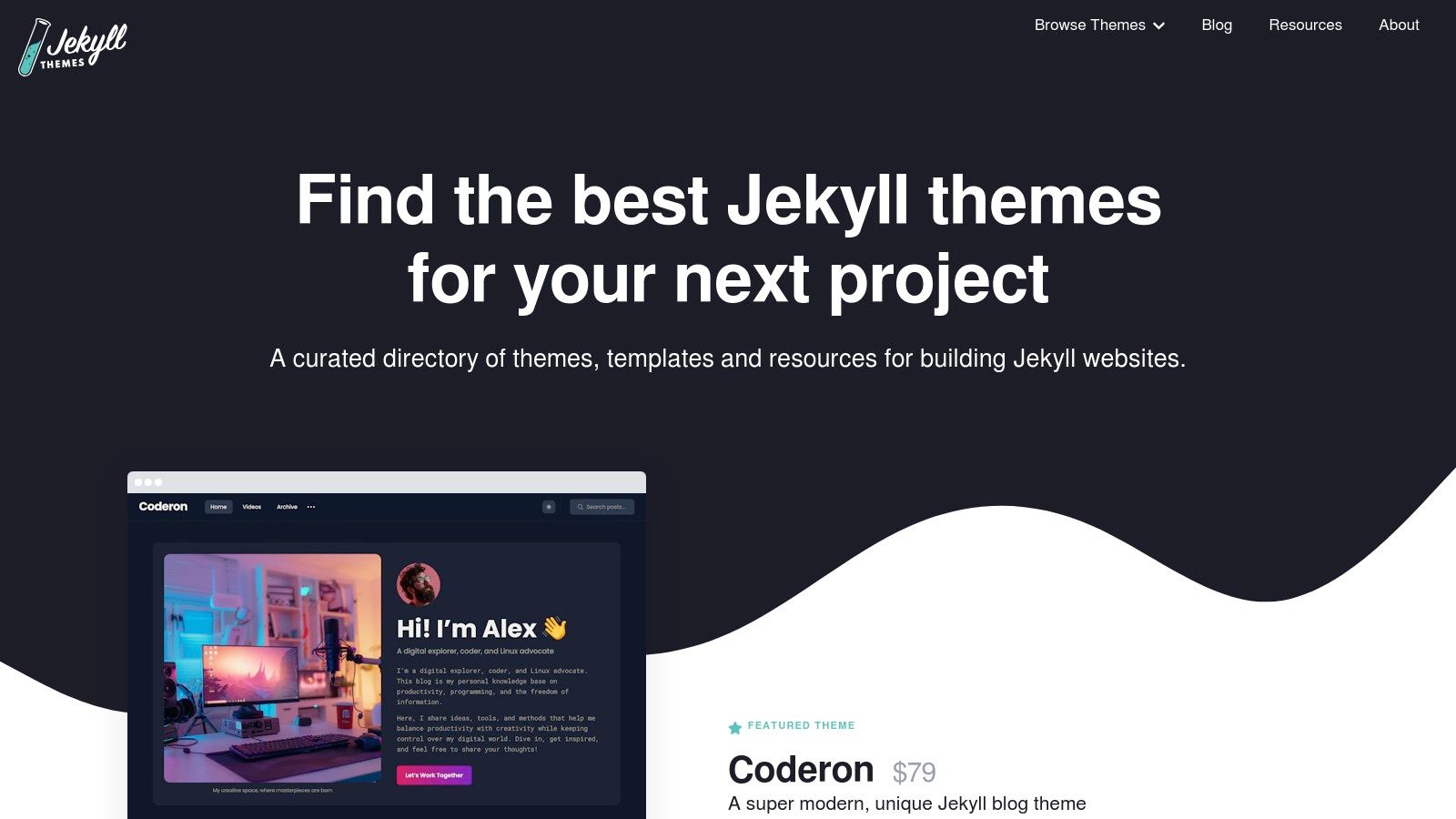
This website stands out by providing a clean, commercial storefront experience. It moves beyond a simple list of open-source projects, offering structured product pages with live demos, clear pricing, and direct links to author information and support channels. This makes it particularly valuable for freelancers, agencies, and non-technical creators who need reliability and a direct line for assistance.
Strategic Analysis and Key Takeaways
The success of Jekyll Themes lies in its focused niche and value proposition. It solves a common pain point in the static site world: the initial setup and design. By curating high-quality themes, it saves developers and content creators countless hours.
- Problem Solved: It dramatically reduces the time and design skill needed to launch a professional-looking Jekyll website.
- Target Audience: Perfectly suited for developers needing a quick start, marketers launching a campaign blog, or writers who want to focus on content, not code.
- Monetization Model: It acts as a marketplace, connecting theme developers with buyers and likely taking a commission on sales of premium themes.
Key Insight: A curated marketplace adds a layer of trust and quality control that a sprawling, unvetted repository cannot. For users who value their time and need a reliable starting point with potential support, a premium theme is a small but worthwhile investment.
How JekyllPad Enhances the Experience
Once a theme is chosen from Jekyll Themes and set up in a GitHub repository, JekyllPad can immediately connect to it. This combination is powerful for teams with mixed technical skills.
- Content Management: Non-technical users can use JekyllPad’s visual editor to write and format posts, edit pages, and manage content without ever touching YAML front matter or Markdown syntax.
- Media Handling: Uploading images, embedding videos, or adding other media is a simple drag-and-drop process inside JekyllPad, which automatically handles file paths and Markdown formatting.
- Simplified Publishing: The entire Git workflow (commit, push) is managed through JekyllPad’s intuitive interface. This allows editors to publish changes directly to GitHub Pages without using the command line, making the powerful Jekyll and GitHub Pages stack accessible to everyone.
2. Astro Themes (official directory)
Astro's official theme directory (astro.build/themes) is the central hub for discovering starters and templates for the increasingly popular Astro framework. Maintained by the core Astro team, it provides a curated and trustworthy catalog of free and premium themes designed for performance. This platform is a prime example of modern static sites examples, showcasing how a framework can foster a healthy ecosystem by providing a clear, official starting point for new projects.
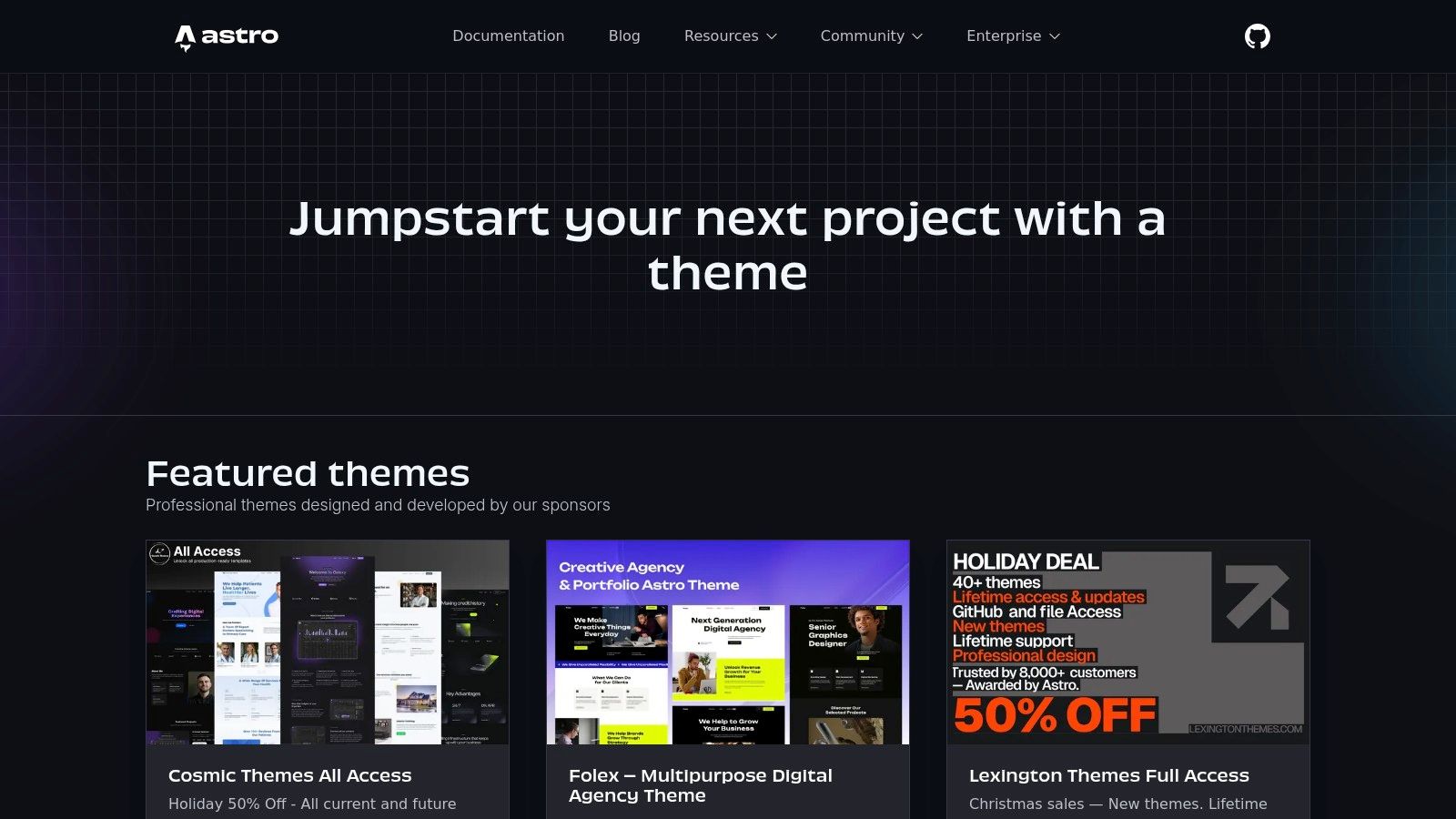
The directory stands out with its developer-centric experience, particularly the one-command installation process for many starters (npm create astro@latest -- --template ...). This dramatically lowers the barrier to entry, allowing developers to go from browsing to a live local development server in minutes. The site features clean filtering by category (blogs, portfolios, e-commerce), live demos for every theme, and direct links to source repositories or vendor pages, ensuring transparency and ease of use.
Strategic Analysis and Key Takeaways
The strength of the Astro Themes directory is its direct integration with the Astro developer workflow and its focus on modern web standards. By being an official resource, it guarantees that themes are generally up-to-date with the latest Astro versions and best practices. It effectively funnels new users into the ecosystem with a smooth and fast onboarding experience.
- Problem Solved: It provides a reliable, curated, and fast way to start a new Astro project with a professional design, avoiding the need to search through unvetted GitHub repositories.
- Target Audience: Developers building performance-focused websites, agencies looking for modern stack templates, and creators who want to leverage Astro's component islands architecture.
- Monetization Model: The directory itself is free, but it facilitates commerce by featuring premium themes from third-party developers, driving traffic to their marketplaces or stores.
Key Insight: An official, framework-endorsed theme directory builds immense trust and accelerates adoption. By making the initial setup seamless with CLI commands, Astro reduces friction and demonstrates the framework's power right from the start.
How JekyllPad Enhances the Experience
After initializing a new site using a theme from the Astro directory and connecting it to a GitHub repository, JekyllPad can streamline the content workflow for the entire team. This is especially useful for Astro sites that use Markdown or MDX for content like blogs or documentation.
- Content Management: JekyllPad’s visual editor allows marketing teams and writers to create and edit pages or blog posts without needing to understand Astro components or front matter syntax.
- Media Handling: Users can easily drag and drop images and other media directly into the editor. JekyllPad manages the file placement within the project's asset directory and generates the correct Markdown for you.
- Simplified Publishing: The complexities of Git are abstracted away. A content editor can simply click "Publish" in JekyllPad to commit their changes and push them to the GitHub repository, triggering a new build and deployment on services like Netlify or Vercel. Learn more about using Astro for your site.
3. Hugo Themes (official community directory)
Hugo's official theme showcase at themes.gohugo.io is the authoritative, continuously updated catalog for its vibrant community. It serves as the primary hub for developers seeking reliable, open-source themes for one of the fastest static site generators. Each theme entry is policy-governed, includes a live demo, and links directly to its source repository, ensuring a baseline of quality and transparency.
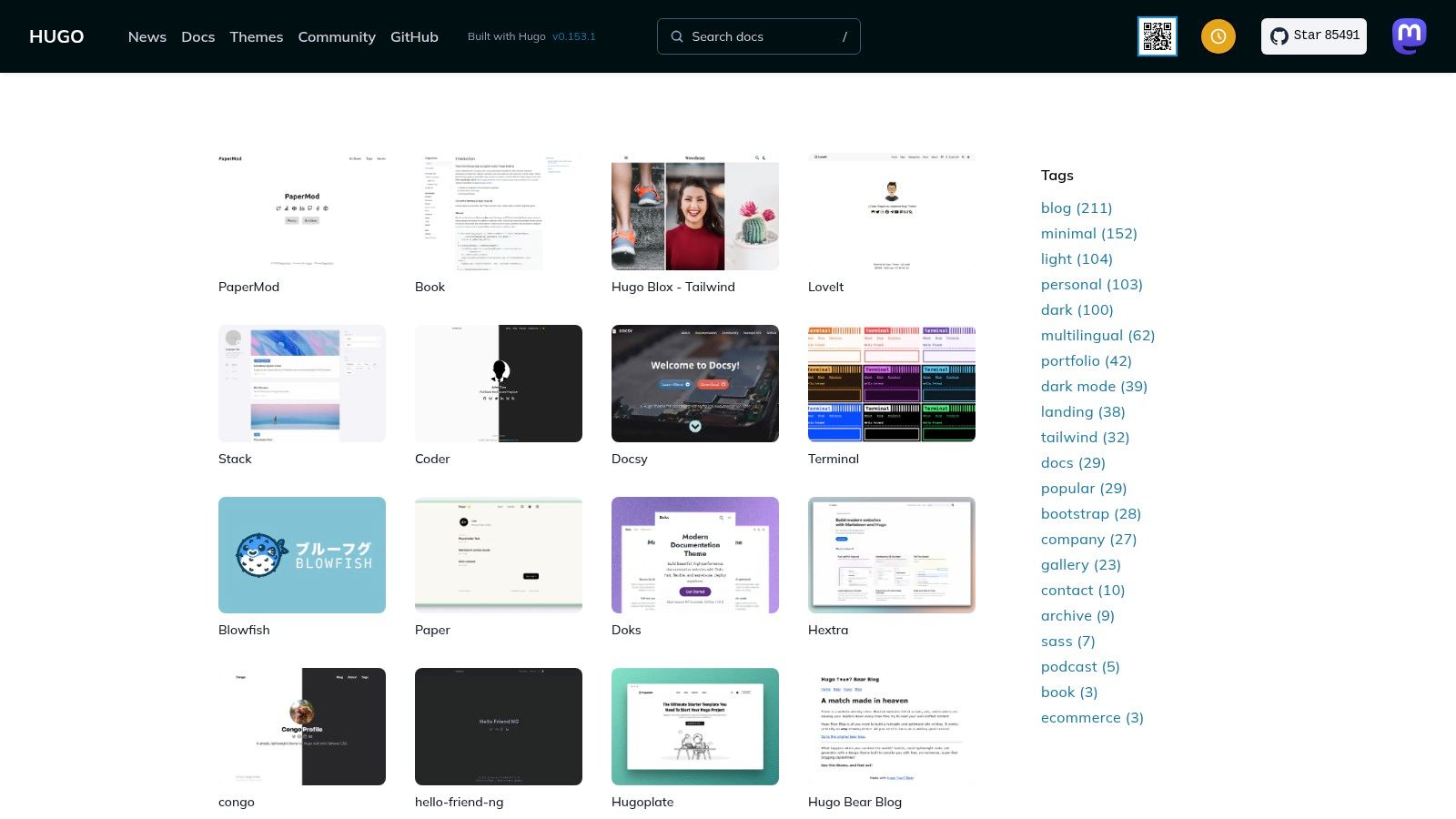
Unlike commercial marketplaces, this directory is entirely free and open-source, reflecting Hugo's community-driven ethos. The platform excels at providing a wide variety of themes for different use cases, with a particularly strong collection for documentation, blogs, and portfolios. Its official status means that themes listed here are more likely to be maintained for long-term compatibility with Hugo's evolving features.
Strategic Analysis and Key Takeaways
The strength of the official Hugo Themes directory lies in its authority and commitment to the open-source community. It provides a trustworthy starting point for any Hugo project, guaranteeing that the foundational code is free to use and modify. This makes it a powerful example of how static sites examples can be fostered through a centralized, well-governed community resource.
- Problem Solved: It offers a reliable, curated, and free source of themes, removing the risk of using outdated or poorly maintained third-party options.
- Target Audience: Ideal for developers, open-source projects, and technical writers who prioritize performance, long-term compatibility, and access to source code.
- Monetization Model: The directory is a community resource and does not have a direct monetization model. Its value is in strengthening the Hugo ecosystem.
Key Insight: An official, policy-governed directory builds immense trust. For teams that value stability and adherence to best practices over premium support, this model provides a secure foundation for building high-performance static websites.
How JekyllPad Enhances the Experience
While Hugo itself is a different static site generator, the workflow of using a theme from a directory and managing content is similar to Jekyll. For teams already using Jekyll, or considering it, JekyllPad streamlines the process after a theme is chosen.
- Content Management: A user could select a Jekyll theme and use JekyllPad’s visual interface to create and manage blog posts, documentation pages, or portfolio entries without writing Markdown by hand.
- Media Handling: JekyllPad simplifies adding images and other media to the site. Users can drag and drop files directly into the editor, and JekyllPad handles the asset paths and Markdown syntax automatically.
- Simplified Publishing: The platform abstracts away the complexities of Git. Content editors can save and publish their changes with a single click, which triggers a commit and push to the GitHub repository, making the site update live on GitHub Pages.
4. Eleventy Starter Projects (official 11ty directory)
The Eleventy Starter Projects directory (11ty.dev/docs/starter/) is the official launchpad for anyone diving into the Eleventy ecosystem. It curates a collection of official and community-submitted starter templates, providing a clean, performance-focused foundation for new projects. This makes it one of the best static sites examples of a generator that prioritizes simplicity and flexibility from the very beginning.
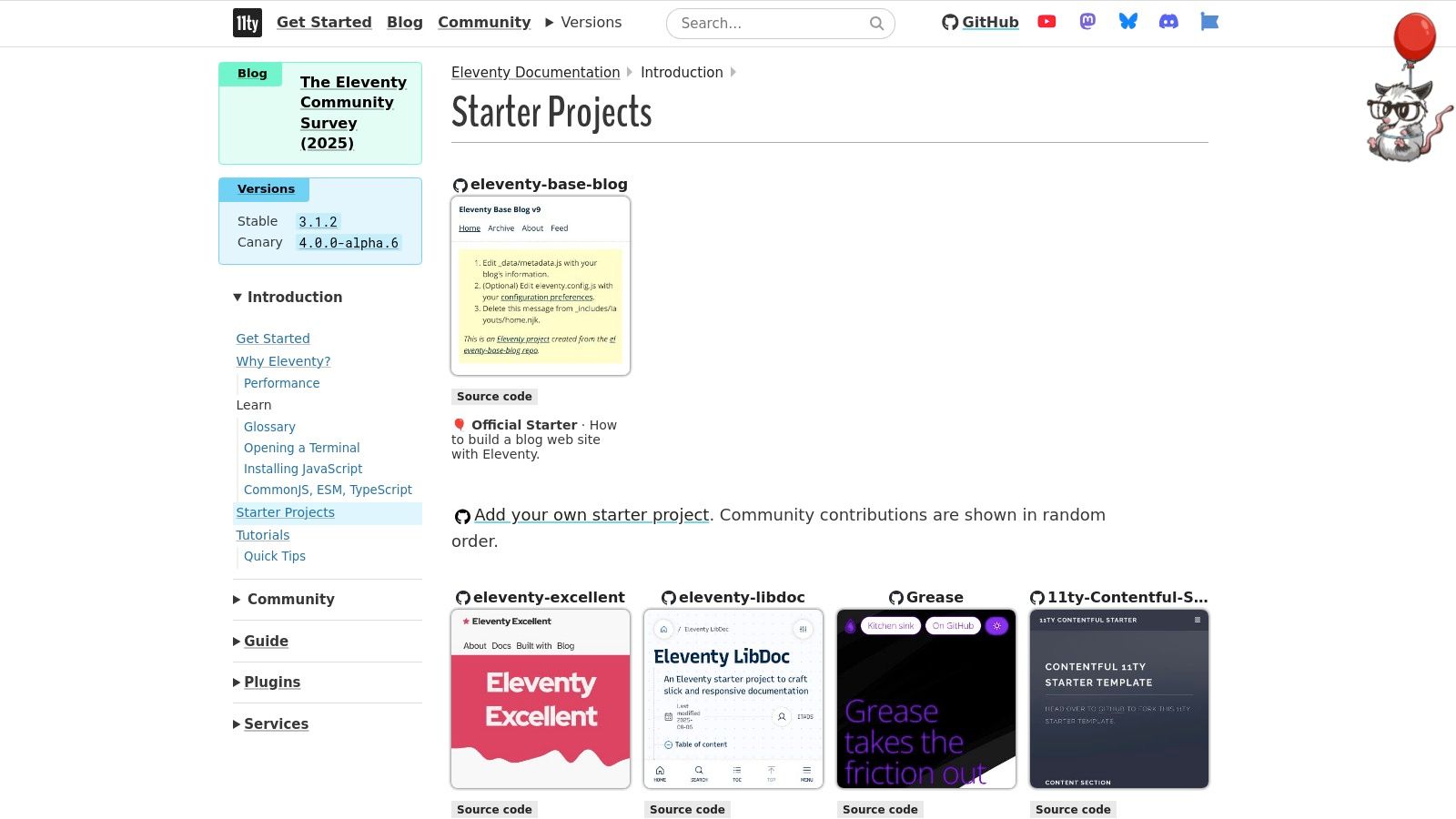
Unlike a commercial theme marketplace, this directory focuses on practical, unopinionated starting points. Starters like eleventy-base-blog offer minimal styling and configuration, empowering developers to build their own design systems without fighting pre-existing CSS frameworks. Each listing provides direct links to the source code repository and one-click deploy buttons for services like Netlify and Vercel, making it incredibly easy to get a project live in minutes.
Strategic Analysis and Key Takeaways
The strength of the Eleventy Starter Projects directory lies in its philosophy of "just enough" to get started. It avoids overwhelming users with complex, feature-heavy themes, instead offering a solid, extensible base that aligns with Eleventy's core principles of simplicity and performance. This approach fosters a deeper understanding of the tool itself.
- Problem Solved: It provides a trusted, minimalist starting point that removes initial setup friction while encouraging customization and learning.
- Target Audience: Ideal for developers who want full control over their front-end stack, technical writers building documentation sites, and creators prioritizing content and performance over off-the-shelf designs.
- Monetization Model: As an official, community-driven resource, it is completely free and non-commercial. Its value is in strengthening the Eleventy ecosystem and promoting best practices.
Key Insight: By focusing on functional, bare-bones starters instead of visually polished themes, Eleventy empowers developers to build truly custom experiences. This "less is more" approach is perfect for projects where performance and unique branding are non-negotiable.
How JekyllPad Enhances the Experience
Once a developer has customized an Eleventy starter and deployed it to a GitHub repository, JekyllPad can be connected to streamline the content workflow. This is especially useful for content-heavy sites built from starters like eleventy-base-blog.
- Content Management: Content creators can use JekyllPad's visual interface to draft, edit, and publish blog posts or documentation pages. This eliminates the need for them to learn Markdown syntax or manage files directly in a code editor.
- Media Handling: Images, diagrams, and other media can be uploaded via a simple drag-and-drop interface within JekyllPad. The platform automatically places the files in the correct directory and generates the necessary Markdown, simplifying a common pain point.
- Simplified Publishing: All content changes are committed and pushed to the GitHub repository through JekyllPad’s intuitive UI. This empowers non-technical team members to manage the entire publishing process without using Git commands, making the powerful and flexible Eleventy stack accessible to the whole team.
5. Jamstack Themes (jamstackthemes.dev)
Jamstack Themes (jamstackthemes.dev) operates as a comprehensive, generator-agnostic directory for static site themes and starters. Unlike platform-specific marketplaces, it provides a bird's-eye view of the entire ecosystem, featuring themes for Astro, Eleventy, Hugo, Jekyll, and more. This makes it an indispensable resource for teams and individuals in the evaluation phase, allowing them to compare visual styles and features before committing to a specific tech stack. It's one of the most useful static sites examples for showcasing community collaboration across different technologies.
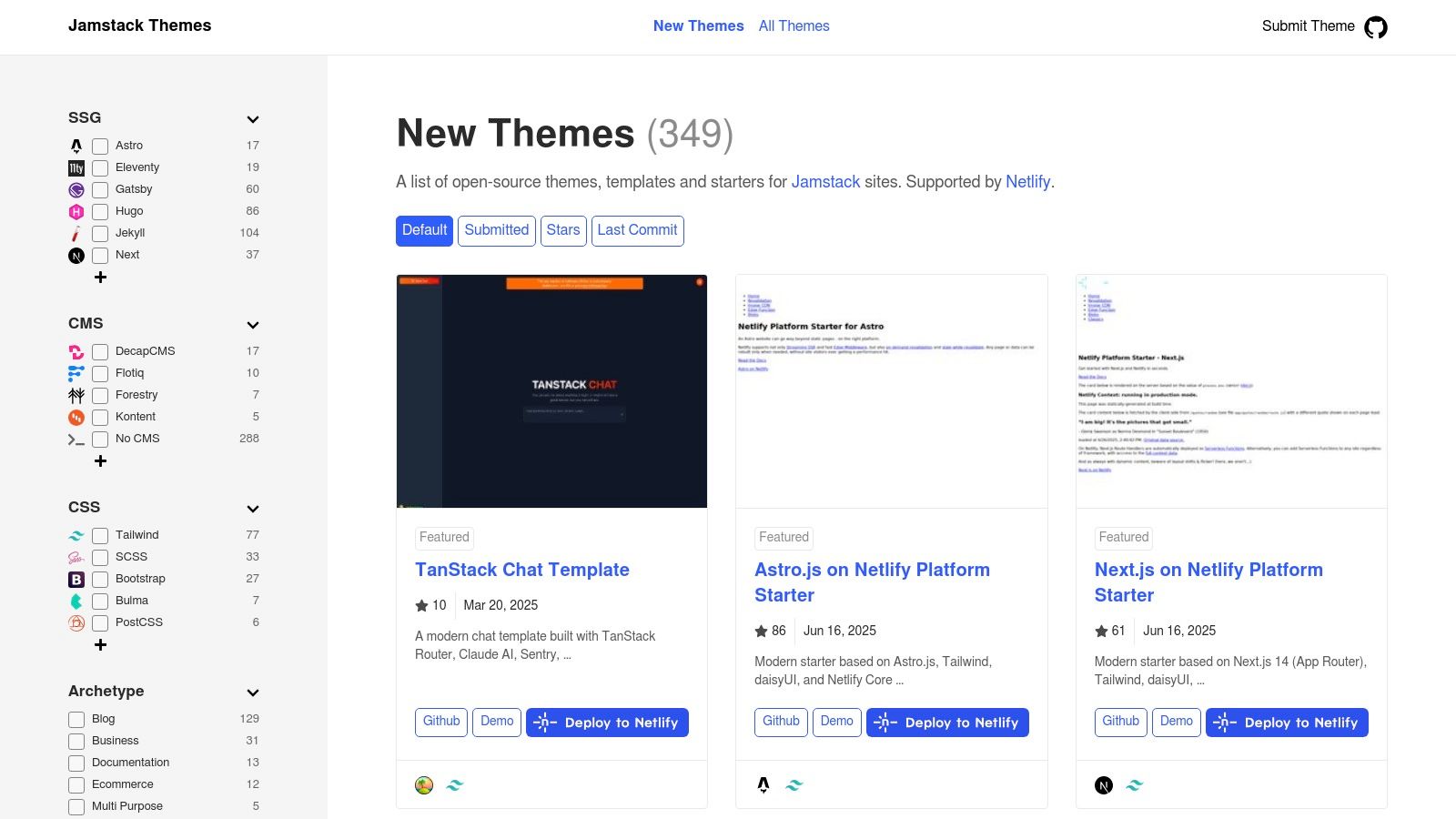
The platform’s power lies in its robust filtering capabilities. Users can narrow down their search by static site generator (SSG), category (e.g., blog, portfolio, e-commerce), CSS framework (like Tailwind or Bootstrap), and even headless CMS compatibility. By aggregating both free, open-source themes and premium options with outbound links, it serves as a neutral starting point for any Jamstack project, valuing breadth and discovery over a curated, single-platform experience.
Strategic Analysis and Key Takeaways
Jamstack Themes thrives by acting as a central, unbiased hub in a fragmented landscape. It addresses the critical "where do I start?" question for newcomers and provides a valuable comparison tool for experienced developers looking to try a new SSG. Its cross-ecosystem approach is its core strategic advantage.
- Problem Solved: It eliminates the need to visit multiple, generator-specific showcases to find a suitable theme, saving significant research time during project initiation.
- Target Audience: Ideal for developers evaluating different SSGs, agencies needing a wide range of starter templates for diverse client projects, and anyone curious about the design trends across the Jamstack ecosystem.
- Monetization Model: The site appears to be community-driven, monetizing primarily through affiliate links for premium themes and potentially sponsorships, rather than direct sales.
Key Insight: A neutral, multi-generator directory fosters discovery and comparison in a way that siloed, official marketplaces cannot. It empowers users to make technology choices based on the best available theme or starter for their specific project, not just what's available within a single ecosystem.
How JekyllPad Enhances the Experience
Jamstack Themes is an excellent place to find a Jekyll starter, and once you select one and set it up on GitHub, JekyllPad seamlessly integrates into the workflow. This combination allows you to leverage the vast selection of community themes while providing a user-friendly content management layer.
- Content Management: Once your chosen Jekyll theme is live, non-technical team members can use JekyllPad's visual editor to create and update content. This abstracts away the complexities of Markdown and Git, making content updates as simple as using a traditional CMS.
- Media Handling: JekyllPad simplifies adding images and other media to posts and pages. Users can drag and drop files directly into the editor, and JekyllPad will automatically handle the upload, file path creation, and Markdown syntax.
- Simplified Publishing: The entire publishing process is streamlined. Editors can save and publish their changes with the click of a button in JekyllPad, which handles the Git commit and push to the GitHub repository behind the scenes. This workflow makes a professionally designed Jekyll site accessible to any content creator.
6. Static Hunt
Static Hunt (static-hunt.vercel.app) functions as a massive, cross-platform aggregator for static site themes and starters. Unlike marketplaces focused on a single generator, it casts a wide net, pulling in thousands of resources for popular frameworks like Jekyll, Hugo, Astro, and Eleventy. This breadth makes it a powerful discovery tool and an essential bookmark for developers looking for diverse static sites examples and starting points.
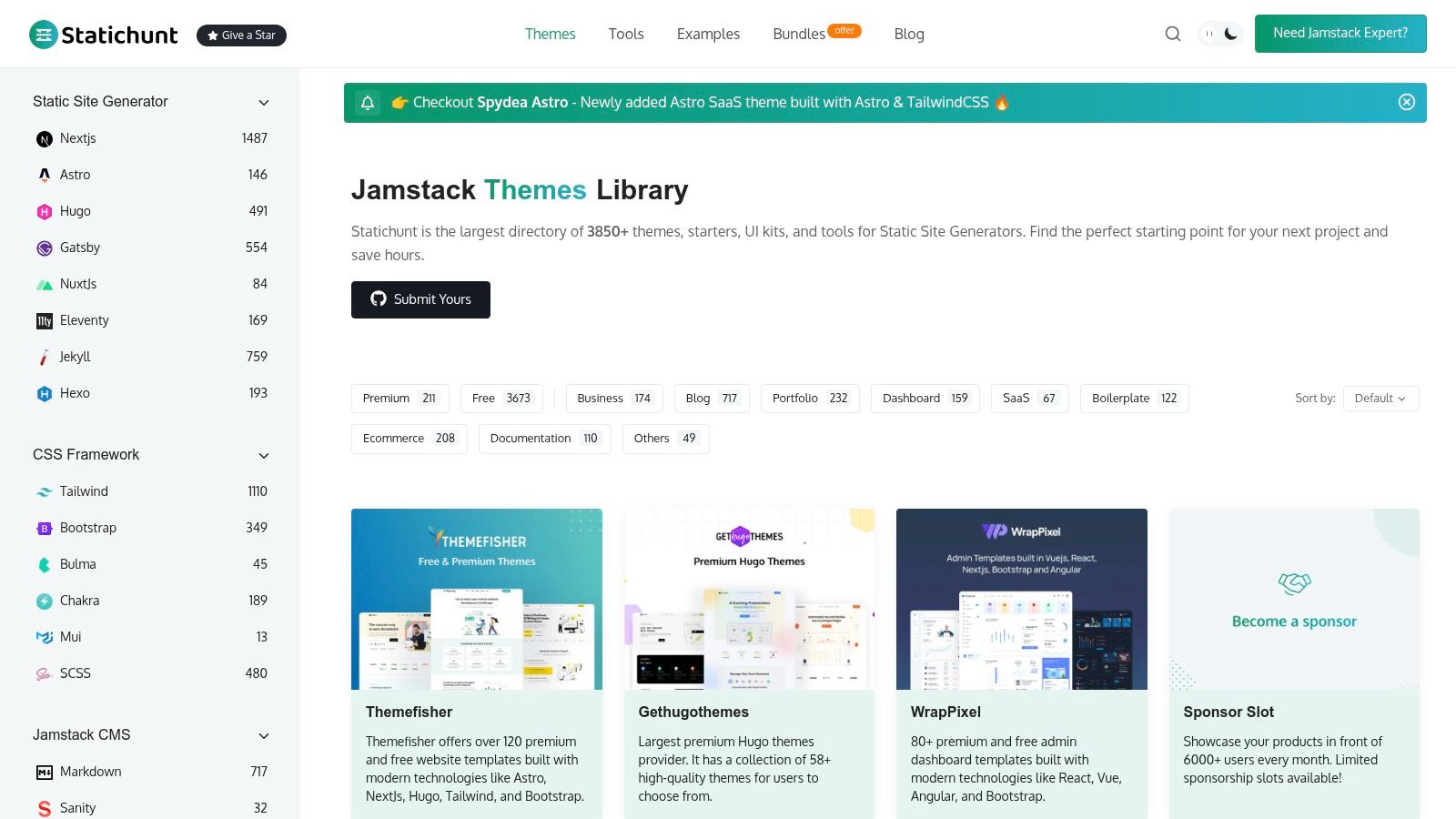
The platform excels with its practical, data-driven interface. Users can quickly filter the extensive collection by static site generator, category (e.g., blog, portfolio, e-commerce), price, and even sort by GitHub stars. This last feature provides an invaluable social proof metric, allowing users to quickly identify which themes are popular, well-maintained, and widely adopted by the community.
Strategic Analysis and Key Takeaways
Static Hunt's value comes from its sheer volume and agnostic approach. By not tying itself to one ecosystem, it becomes a one-stop-shop for exploration, saving developers the effort of visiting multiple separate directories. It democratizes discovery by placing community-driven open-source projects alongside premium commercial offerings.
- Problem Solved: It consolidates the fragmented theme landscape into a single, searchable interface, drastically speeding up the initial theme selection process for any major static site generator.
- Target Audience: Web developers, agencies, and freelancers who work with various static site generators and need to rapidly find and evaluate themes for new projects.
- Monetization Model: Primarily a free discovery tool. It likely relies on affiliate links for premium themes and may feature sponsored placements from theme developers or vendors seeking visibility.
Key Insight: In a diverse ecosystem, aggregation and intelligent filtering are king. By leveraging public data like GitHub stars, Static Hunt provides a layer of community-vetted quality control that helps users navigate thousands of options with confidence.
How JekyllPad Enhances the Experience
Static Hunt is the starting line; JekyllPad is the engine that drives the content forward after a theme is chosen. Once you find a Jekyll theme on Static Hunt and deploy it to a GitHub repository, JekyllPad makes it instantly accessible to your entire team.
- Content Management: A marketer or writer can use JekyllPad's intuitive editor to manage blog posts and pages on the chosen theme. They can create new content, update existing articles, and adjust metadata without needing to understand the underlying Jekyll file structure.
- Media Handling: The process of adding images or other assets is simplified to a drag-and-drop action. JekyllPad handles the file upload to the correct repository folder and inserts the necessary Markdown, a common pain point for non-technical users.
- Simplified Publishing: JekyllPad abstracts away the entire Git workflow. Instead of command-line operations, a content editor simply hits a "Publish" button, which triggers the commit and push to GitHub, deploying the changes live. This workflow makes even the most complex themes from Static Hunt manageable for anyone.
7. Jekyll Themes (jekyllthemes.io)
Jekyll Themes (jekyllthemes.io) serves as a vital resource and marketplace for anyone looking to launch a polished Jekyll site quickly. Instead of building from scratch, users can browse a curated directory of free and premium themes, making it an excellent starting point for one of the most classic static sites examples of a community-driven ecosystem. The platform specializes in themes that are often designed for seamless compatibility with GitHub Pages, lowering the technical barrier for deployment.
This website stands out by providing a clean, commercial storefront experience. It moves beyond a simple list of open-source projects, offering structured product pages with live demos, clear pricing, and direct links to author information and support channels. This makes it particularly valuable for freelancers, agencies, and non-technical creators who need reliability and a direct line for assistance.
Strategic Analysis and Key Takeaways
The success of Jekyll Themes lies in its focused niche and value proposition. It solves a common pain point in the static site world: the initial setup and design. By curating high-quality themes, it saves developers and content creators countless hours.
- Problem Solved: It dramatically reduces the time and design skill needed to launch a professional-looking Jekyll website.
- Target Audience: Perfectly suited for developers needing a quick start, marketers launching a campaign blog, or writers who want to focus on content, not code.
- Monetization Model: It acts as a marketplace, connecting theme developers with buyers and likely taking a commission on sales of premium themes.
Key Insight: A curated marketplace adds a layer of trust and quality control that a sprawling, unvetted repository cannot. For users who value their time and need a reliable starting point with potential support, a premium theme is a small but worthwhile investment.
How JekyllPad Enhances the Experience
Once a theme is chosen from Jekyll Themes and set up in a GitHub repository, JekyllPad can immediately connect to it. This combination is powerful for teams with mixed technical skills.
- Content Management: Non-technical users can use JekyllPad’s visual editor to write and format posts, edit pages, and manage content without ever touching YAML front matter or Markdown syntax.
- Media Handling: Uploading images, embedding videos, or adding other media is a simple drag-and-drop process inside JekyllPad, which automatically handles file paths and Markdown formatting.
- Simplified Publishing: The entire Git workflow (commit, push) is managed through JekyllPad’s intuitive interface. This allows editors to publish changes directly to GitHub Pages without using the command line, making the powerful Jekyll and GitHub Pages stack accessible to everyone.
7 Static Site Theme Directories Compared
| Item | 🔄 Implementation complexity | ⚡ Resource requirements | 📊 Expected outcomes | 💡 Ideal use cases | ⭐ Key advantages |
|---|---|---|---|---|---|
| ThemeForest | 🔄 Medium — plain HTML templates that often require adaptation to SSGs; quality varies by author | ⚡ Paid one‑time purchases; moderate dev time to convert; often includes 6 months support | 📊 Polished, client‑ready HTML deliverables for quick launches | 💡 Agencies, client projects, landing pages, rapid prototyping | ⭐ Massive selection, mature marketplace, predictable pricing |
| Astro Themes (official) | 🔄 Low — curated starters with one‑command installs and updated for Astro | ⚡ Low–medium; mix of free and paid themes; requires Astro toolchain | 📊 Modern, performance‑focused sites with partial hydration | 💡 New Astro projects, performance‑oriented blogs/docs/portfolios | ⭐ Official, up‑to‑date, fast install flow |
| Hugo Themes (official) | 🔄 Low — themes built for Hugo with policy governance and stable compatibility | ⚡ Low — entirely free OSS; requires Hugo familiarity | 📊 Reliable long‑term compatibility, strong docs/site examples | 💡 Documentation sites, blogs, teams prioritizing stability | ⭐ Authoritative curated directory; OSS licensing |
| Eleventy Starter Projects | 🔄 Low — minimal, easy‑to‑clone starters that are easy to extend | ⚡ Low — free starters; basic Eleventy knowledge sufficient | 📊 Lean, content‑first sites with simple, maintainable structure | 💡 Small blogs, docs, learning Eleventy, simple publish pipelines | ⭐ Minimal overhead; clear best‑practice starters |
| Jamstack Themes | 🔄 Medium — cross‑SSG listings require choosing/adapting per stack | ⚡ Variable — mix of free and paid; filtering helps narrow choices | 📊 Broad comparison across ecosystems to inform decisions | 💡 Evaluating stacks, migrating between SSGs, cross‑SSG research | ⭐ Wide coverage and useful filters across multiple SSGs |
| Static Hunt | 🔄 Medium — large aggregator; requires checking repo activity and duplicates | ⚡ Variable — extensive free/premium mix; filtering by stars/price | 📊 Very large catalog with popularity signals (GitHub) for discovery | 💡 Rapid discovery of many options, spotting active/popular projects | ⭐ Huge index and useful GitHub popularity indicators |
| Jekyll Themes (jekyllthemes.io) | 🔄 Low — themes designed for Jekyll and GitHub Pages compatibility | ⚡ Mix of free and premium; aimed at non‑technical deployers | 📊 Ready‑to‑deploy Jekyll sites with demos and author support info | 💡 Creators using Jekyll + GitHub Pages who want turnkey themes | ⭐ Curated storefront experience with demos and support details |
From Inspiration to Publication: Streamlining Your Static Site Workflow
We've journeyed through an extensive collection of high-quality static sites examples, from the polished commercial themes on ThemeForest to the community-driven starter projects in the official Astro, Hugo, and Eleventy directories. Each example serves as a powerful testament to a core principle: modern static sites deliver elite performance, robust security, and stunning design without the complexity of traditional monolithic systems. The diversity on display, from minimalist blogs to feature-rich e-commerce storefronts, proves that static site generators are no longer niche tools but a mainstream solution for building the future of the web.
The common thread weaving through these successful projects is a Git-based workflow. This developer-centric foundation provides unparalleled version control, atomic deploys, and collaboration. However, as we've analyzed, this very strength can become a significant bottleneck for non-technical content creators, writers, and marketers. The friction of learning Git, navigating YAML front matter, and managing local development environments often prevents the very people responsible for content from contributing efficiently.
Key Takeaways from Our Examples
Reflecting on the curated showcases, several strategic patterns emerge that you can apply directly to your next project:
- Performance is a Feature: The sites built with Hugo and Astro, in particular, demonstrate an uncompromising focus on speed. They achieve near-perfect Lighthouse scores not by accident, but through intentional architectural choices like minimal client-side JavaScript and pre-rendering.
- Modularity is Power: Eleventy and Jekyll examples highlight the power of component-based design. By breaking down UIs into reusable partials and includes, teams can maintain design consistency and accelerate development.
- Content and Code Separation: The most effective static sites strictly separate content (Markdown files) from presentation (templates and styles). This fundamental discipline is what enables a tool like JekyllPad to seamlessly integrate, allowing content teams to work on their part of the puzzle without ever touching the underlying code.
Choosing Your Path Forward
Selecting the right static site generator depends entirely on your project's specific needs and your team's skillset.
- For Blazing Speed & Large Sites: Hugo is an unmatched choice, especially for content-heavy sites like blogs or documentation portals where build time is a critical factor.
- For Modern JavaScript & APIs: Astro provides a cutting-edge "islands architecture" that is perfect for interactive marketing sites that need to integrate with multiple third-party services while shipping minimal JavaScript.
- For Ultimate Flexibility & Control: Eleventy offers a highly configurable, JavaScript-based approach that gives developers fine-grained control over every aspect of the build process.
- For a Mature Ecosystem: Jekyll, the pioneer in the space, boasts a massive community and a wealth of themes and plugins, making it a reliable and stable choice.
Regardless of the generator you choose, the challenge of content management remains. The strategic goal should always be to empower your entire team to contribute content without friction. Forcing a marketer to clone a Git repository and run a local server is a recipe for inefficiency. This is where you must bridge the gap between developer workflow and content creation. Instead of compromising the integrity of your static architecture with a heavy, database-driven CMS, the solution is to introduce a lightweight, Git-native content editor.
This approach preserves all the benefits of your static site-speed, security, and scalability-while providing a familiar, intuitive interface for your content team. They can write, edit, manage media, and update front matter through a simple web-based UI, with every change automatically committed to your GitHub repository. This is the key to unlocking true velocity and making your static site a collaborative success.
Ready to eliminate the content bottlenecks in your workflow? JekyllPad provides an intuitive, browser-based visual editor that connects directly to your GitHub repository, empowering your entire team to manage content on Jekyll, Hugo, Astro, or Eleventy sites without ever touching a line of code. See how our seamless Git-based approach can transform your process by trying JekyllPad today.